Rooting Efficiency and Early Growth Response of Eucalyptus Clones Propagated via Tissue-Culture and Conventional Plantlets as Mother Plants
This study assessed the juvenile vegetative development of Tissue Culture Plantlets (TCP) versus Conventional Cuttings Plantlets (CCP) in Eucalyptus hybrid clones SPM 85 (E. urophylla × E. grandis). Read more …
Mishra A K* 
Narkhede S L
Rajesh R
Naveen Kumar A T
Eucalyptus is a fast-growing species and a primary raw material for India’s pulp and paper industry, with productivity dependent on efficient clonal propagation of superior genotypes. This study assessed the juvenile vegetative development of Tissue Culture Plantlets (TCP) versus Conventional Cuttings Plantlets (CCP) in Eucalyptus hybrid clones SPM 85 (E. urophylla × E. grandis). A total of 1,500 apical shoot cuttings each from TCP and CCP were collected and maintained under mist chamber conditions. Survival percentage, shoot height, leaf number, root length, root volume, and root–shoot ratio were recorded at 45 days after planting. Cuttings originating from tissue culture exhibited significantly higher rooting success and superior early growth compared to those from conventional mother bed sources. Randomized block ANOVA and mixed effects model analyses revealed significant differences in shoot length, root length, new leaves, and root volume (p < 0.001), whereas root shoot ratio did not differ significantly. These findings emphasize the critical role of mother plant origin and physiological status, and the integration of tissue culture with optimized mother plant management for large-scale production of high quality Eucalyptus clones. The enhanced establishment performance and early vigour observed in TCP derived cuttings highlighted their potential to improve nursery efficiency, reduce production cycles, and ensure uniform planting material.
Eucalyptus hybrid, Clonal propagation, Mini-cuttings, Tissue culture, Rooting performance, Early growth
1 Introduction
The genus Eucalyptus (Family: Myrtaceae; 2n = 22), consisting of more than 900 species, is native to Australia but is now extensively cultivated in tropical and subtropical regions, including India. Its rapid growth, short rotation period, adaptability to varied environmental conditions, and suitability for multiple industrial applications such as pulp and paper, bioenergy, timber and plywood make Eucalyptus one of the most important plantation forestry species globally. Increasing domestic and industrial demand for high quality wood biomass continues to drive the need for efficient propagation systems to support large scale plantation expansion (Naickar et al. 2024).
Efficient nursery management, coupled with rapid and cost effective clonal propagation, is essential for the successful establishment of plantations. Mass propagation plays a critical role in enhancing the competitiveness of the forest based industry. However, in Eucalypts, conventional stem cutting techniques are associated with several limitations, including a progressive decline in rooting capacity, intra clonal variability, and inferior root system quality. These constraints hinder the optimal expression of genetic potential in elite clones and consequently limit their large scale deployment under field conditions (Bindumadhava et al. 2011).
Although micropropagation of Eucalyptus has received considerable attention as a means of producing disease free and genetically uniform clonal plants for reforestation and industrial plantations, its application at a large commercial scale remains limited. The mini cutting technique developed by (T. F. Assis, Fett-Neto, and Alfenas 2004) has demonstrated high efficiency for large scale Eucalyptus propagation by overcoming major limitations of conventional cutting methods, particularly the reduced rooting capacity of certain clones resulting from physiological maturation of the donor plants (P. K. Gupta and Durzan 1987; Hackett 1987). Low rooting ability in certain Eucalyptus clones propagated through conventional cuttings remains a major limitation in clonal forestry. This constraint has largely been attributed to the maturation status of the plant material (Hackett 1987), which has prompted the adoption of various rejuvenation techniques aimed at restoring mature tissue to a juvenile physiological stage (Bonga 1982). Several methods have been explored for this purpose (Struve and Lineberger 1988; P. K. Gupta and Durzan 1987; George 1993; Hartmann et al. 2002). The subsequent development of micro cutting technology (T. F. de Assis, Fett-Neto, and Alfenas 2004) and mini-cuttings technique (R. N. R. Trindade et al. 2026) established for substantial improvements in clonal production.
In recent times, considerable attention on micropropagation of Eucalyptus has been given to produce large scale Eucalyptus clonal plants for reforestation and raising industrial plantations owing to the advantages of producing disease free and genetically identical plantlets. Well established in vitro propagation protocols for various Eucalyptus species were reported by some researchers (Kamal et al. 2016; Shwe and Leung 2020; Singh, Kaur, and Kumar 2020; Souza et al. 2022). To further enhance the production of vigorous saplings from TCP-based mother plants, an efficient propagation approach was employed to improve survival, accelerate rooting, and promote early establishment.
Two alternative super intensive systems for commercial-scale cloning of Eucalyptus have demonstrated substantial potential for technical and economic advantages in clonal production. The micro cutting system employs apices derived from micro propagated plantlets, whereas the mini cutting system relies on rooting axillary shoots from rooted stem cuttings. In both systems, plants are managed intensively to maximize production of small cuttings (T. F. Assis, Fett-Neto, and Alfenas 2004).
Our hypothesis posits that Eucalyptus micro cutting propagule constellations (TCP) based stock plants exhibit high juvenile vigour, making them particularly suitable for clonal propagation. These juveniles generate high quality apical shoots, which enhance rooting potential, accelerate rooting speed, and improve overall root system quality, thereby reducing nursery costs. Propagules derived from TCP based mothers in a highly juvenile state can be exploited to produce high-quality clonal plant material more efficiently.
Conventional mini cuttings propagation is often constrained by low rooting efficiency, physiological maturity of mother plants, and clone specific rooting variability (T. F. Assis, Fett-Neto, and Alfenas 2004). To overcome these challenges, advanced clonal propagation techniques such as tissue culture derived mini-cuttings have been adopted in forestry programs. Tissue culture derived plants provide genetically uniform and pathogen free mother stock; however, their rooting efficiency during acclimatization and early growth stages may vary among clones. Conversely, mini cuttings collected from rejuvenated clonal hedges have shown higher rooting percentages, greater physiological vigor and overall improved performance compared with cuttings taken from older, non rejuvenated sources.
Therefore, the objective of this study is to compare the rooting efficiency and early growth response of the Eucalyptus hybrid clone SPM-85 (E. urophylla × E. grandis) propagated through mini cuttings from Tissue Culture Plantlets (TCP) and Conventional Cuttings Plantlets (CCP). The findings aim to support decision making in commercial nursery management and contribute to the refinement of clonal forestry practices for high rooting performance and early growth Eucalyptus production systems in India.
2 Materials and methods
2.1 Study location and experimental conditions
The present study was conducted at the Clonal Propagation and Research Development Centre of The Sirpur Paper Mills Ltd. (a unit of JK Paper Ltd.), located in Telangana, India. The experimental site falls under a semi arid tropical climatic zone, characterized by hot summers, mild winters, and moderate but seasonal rainfall. The region receives an average annual rainfall of 850–900 mm, most of which occurs during the southwest monsoon period between June and September. The mean maximum temperature during peak summer months reaches approximately 38 °C, whereas the mean minimum temperature during winter months falls to approximately 12 °C. These climatic conditions are representative of major pulpwood-growing regions in southern India, making the site suitable for evaluating clonal propagation performance under operational nursery conditions.
All experiments were conducted in a naturally ventilated polyhouse designed for vegetative propagation. The polyhouse was equipped with automated misting and adjustable shading systems to maintain optimal conditions for rooting and early growth of Eucalyptus mini cuttings (Joshi, Negi, and Rawat 2016). The misting system ensured uniform moisture availability by regulating air humidity and reducing transpiration losses during the critical rooting phase. Shading arrangements were used to regulate light intensity and prevent heat stress during peak daytime temperatures. Environmental parameters, including air temperature, relative humidity, and light intensity, were monitored regularly using digital sensors to ensure consistency throughout the experimental period. Any deviations from the desired range were corrected through adjustments in misting frequency or shading intensity, thereby minimizing environmental variability across treatments.
2.2 Vegetative multiplication garden
Mother plants originating from TCP and CCP were established as clonal hedges in a vegetative multiplication garden following standardized protocols for Eucalyptus clonal propagation (Ferreira, Xavier, and Wendling 2004). The objective of maintaining a dedicated multiplication garden was to ensure a continuous and uniform supply of physiologically juvenile shoots suitable for mini cutting production. The hedges were established in raised cement brick lined sand beds to provide adequate drainage, prevent waterlogging, and facilitate root aeration. Beds were filled with clean river sand to create an inert growing medium that minimized pathogen buildup and allowed precise control of nutrient inputs.
Plant spacing within the sand beds was maintained uniformly at 10 × 10 cm to promote consistent shoot emergence and ease of cultural operations such as irrigation, fertilization, and harvesting. Manual irrigation practices was adopted to ensure adequate moisture availability without excessive wetting of the foliage. Fertilization was carried out using a standardized nutrient solution prepared based on the nutritional requirements of Eucalyptus hedges. The nutrient solution was adjusted to the appropriate pH and applied daily to the rooting zone using a hand operated sprayer to promote vigorous shoot growth and maintain hedge productivity. Nutrient concentrations were carefully monitored and regulated to avoid deficiencies or toxicities, ensuring continuous production of healthy, disease free shoots.
The first harvest of mini cuttings was carried out approximately one month after hedge establishment, once the plants had acclimatized and produced sufficient new growth. Subsequent harvests were conducted on a weekly basis as new shoots reached a harvestable length of 6–10 cm. During the entire production cycle, adequate moisture levels were maintained using a tap-water sprinkler system to prevent desiccation, particularly during high temperature periods. Regular monitoring of pest and disease incidence and sanitation practices like removal of senescent leaves were followed to maintain the physiological health and productivity of the mother plants.
2.3 Planting material and mini cuttings preparation
Apical shoots measuring approximately 6–10 cm in length were initially excised from the clonal hedges maintained in the sand beds. These shoots were further trimmed to include 2–4 nodes and were referred to as mini cuttings. Only young, actively growing lateral shoots were selected to ensure high rooting potential and uniform physiological status. Shoots were harvested using clean, sterilized scissors to minimize mechanical damage and reduce the risk of pathogen contamination. Immediately after harvest, the cut shoots were placed in a thermocol box lined with moist material to prevent dehydration and maintain turgidity during transport to the processing area.
In the processing area, the mini cuttings were further standardized by trimming them to a uniform size consisting of two nodes and one internode. This standardization was essential to reduce variability among cuttings and to ensure consistent exposure to rooting conditions. All leaf trimming and cutting operations were performed carefully to avoid excessive tissue damage. Prepared mini cuttings were inserted into root trainers containing the rooting substrate within 15 minutes of preparation to minimize moisture loss and physiological stress.
The rooting substrate used for the experiment consisted of coir pith and carbonized rice husk mixed in a ratio of 70:30 (%). This substrate was selected due to its constructive physical properties, including adequate aeration, good moisture retention, low bulk density, and inert nature. Root trainer technology was employed for rooting of Eucalyptus mini cuttings, as it facilitates proper root architecture development, prevents root coiling, and improves transplant success (Alfenas et al. 1997; Rawat and Dhiman 2002). Root trainers were selected with appropriate dimensions to support optimal root growth while maintaining sufficient moisture without water stagnation. The rooting medium was maintained as lightweight and well drained to prevent excess moisture, root rot, and fungal infections.
Mini cuttings were maintained in the mist chamber under controlled conditions, with an average relative humidity of 85% and a temperature of approximately 38 °C for about two weeks. These conditions were maintained to promote callus formation and adventitious root initiation. Once rooting was observed, the plantlets were transferred to a shade house for acclimatization for a period of three days under 50% light intensity. This gradual acclimatization helped reduce transplant shock and improved survival. Following this period, the rooted plantlets were exposed to full sunlight to harden them for further nursery growth and eventual field planting.
2.4 Rooting conditions
Root trainers containing the mini cuttings were maintained under controlled environmental conditions at 38 ± 2 °C and relative humidity ranging between 80 and 85%. Misting was scheduled at regular intervals of every 20 minutes for a duration of 60 seconds to maintain optimal moisture levels on the cutting surfaces and surrounding air. A photoperiod of 9 hours was maintained to simulate operational nursery conditions and support physiological activity during rooting.
2.5 Experimental design
The experiment was conducted using a single Eucalyptus hybrid clone (EU × EG), with two sources of mother plants: TCP and CCP. The experimental layout followed a randomized block design to minimize the effects of environmental heterogeneity within the polyhouse. Each treatment consisted of three replications, with 500 mini cuttings per replication, resulting in a robust sample size for statistical analysis. All cultural practices were kept uniform across treatments to ensure that any observed differences in rooting and growth parameters could be attributed solely to the origin of the mother plants.
2.6 Data collection and statistical analysis
Data collection was carried out at 45 days after planting, a stage considered appropriate for evaluating rooting success and early growth performance of Eucalyptus mini cuttings (Schwambach et al. 2008). Observations were recorded on shoot length, root length, number of new leaves, root volume, and root shoot ratio. Rooting success was assessed using 30 randomly selected cuttings per treatment to provide a representative estimate of rooting performance (Joshi, Negi, and Rawat 2016; Naickar et al. 2024).
All collected data were subjected to statistical analysis using IBM SPSS v29.0 software. Results were expressed as means ± standard error (SE). Analysis of variance (ANOVA) was employed to test for statistically significant differences between treatments at p≤0.05. Where applicable, appropriate post hoc comparisons were conducted to further interpret treatment effects. This analytical approach ensured rigorous evaluation of the influence of mother plant origin on rooting efficiency and early growth parameters of Eucalyptus hybrid mini-cuttings.
3 Results
3.1 Survival and rooting efficiency
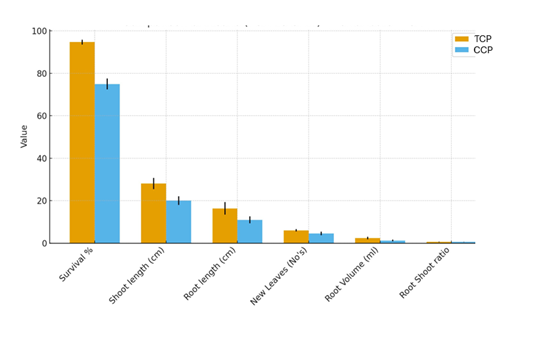
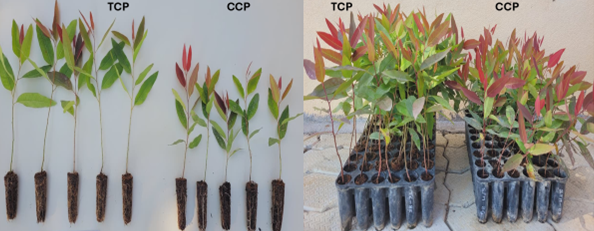
TCP demonstrated a markedly higher survival percentage of 94.73% during the acclimatization phase compared to CCP, which recorded a survival rate of only 75%. Root initiation in TCP cuttings occurred within 6–8 days, which was noticeably faster than that observed in CCP cuttings Figure 1.
3.2 Early growth performance
Quantitative assessment of early growth parameters revealed significant differences between TCP and CCP derived cuttings. TCP cuttings produced significantly longer shoots (28.20 ± 0.92 cm) and roots (16.40 ± 0.84 cm) compared to CCP cuttings, which recorded shoot and root lengths of 20.50 ± 0.81 cm and 11.00 ± 0.64 cm, respectively. Leaf initiation followed a similar trend, with TCP cuttings producing a greater number of new leaves (6.0 ± 0.32) than CCP cuttings (4.6 ± 0.28) (Table 1; Table 2).
| Treatment | Shoot Length (cm) | Root Length (cm) | New Leaves (No.) | Root Volume (ml) | Root–Shoot Ratio |
|---|---|---|---|---|---|
| TCP | 28.20 ± 0.92 | 16.40 ± 0.84 | 6.00 ± 0.32 | 2.30 ± 0.25 | 0.57 ± 0.03 |
| CCP | 20.50 ± 0.81 | 11.00 ± 0.64 | 4.60 ± 0.28 | 1.20 ± 0.14 | 0.54 ± 0.02 |
| Variable | Group | Mean | SD | CV% |
|---|---|---|---|---|
| Survival % | TCP | 94.733 | 1.163 | 1.228 |
| CCP | 75.000 | 2.591 | 3.455 | |
| Shoot length (cm) | TCP | 28.100 | 2.687 | 9.563 |
| CCP | 20.000 | 2.027 | 10.133 | |
| Root length (cm) | TCP | 16.367 | 2.943 | 17.980 |
| CCP | 10.967 | 1.609 | 14.670 | |
| New Leaves (No’s) | TCP | 6.000 | 0.535 | 8.909 |
| CCP | 4.533 | 0.834 | 18.393 | |
| Root Volume (ml) | TCP | 2.367 | 0.581 | 24.569 |
| CCP | 1.200 | 0.414 | 34.503 | |
| Root Shoot ratio | TCP | 0.589 | 0.127 | 21.534 |
| CCP | 0.550 | 0.066 | 12.021 |
3.3 Root system development
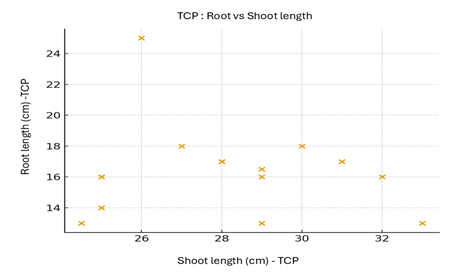
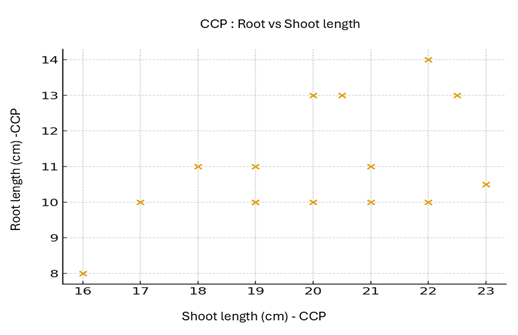
Root system characteristics differed significantly between TCP and CCP derived cuttings (Figure 2; Figure 3). TCP cuttings exhibited greater root length and higher root volume, reflecting more vigorous root initiation and elongation. In contrast, CCP cuttings produced finer and more fibrous root systems, with overall lower root volume and elongation.
3.4 Leaf initiation and vigour
TCP cuttings demonstrated a significantly higher rate of leaf initiation and overall vegetative vigour compared to CCP cuttings (Figure 4). Additionally, TCP cuttings exhibited more uniform growth patterns across replicates, whereas CCP cuttings were associated with greater variability and increased mortality rates, particularly during the mist chamber stage.
4 Discussion
The significantly higher survival observed in TCP derived cuttings highlights the valuable influence of mother plant origin on early establishment success. Similar trends have been reported in earlier studies, where tissue culture derived mother plants exhibited superior physiological quality and stress tolerance during the rooting and acclimatization phases (Naickar et al. 2024). The accelerated root initiation in TCP cuttings can be attributed to the maintained juvenility and higher meristematic activity of tissue culture derived mother plants. Juvenile tissues are known to possess greater cellular plasticity, enhanced metabolic activity, and increased sensitivity to endogenous and exogenous rooting signals, all of which are essential for adventitious root formation. In contrast, CCP mother plants often undergo gradual physiological aging, leading to increased lignification, reduced auxin sensitivity, and diminished rooting competence.
The higher survival and faster rooting observed in TCP cuttings also suggest improved water relations and reduced desiccation stress under mist chamber conditions. Efficient stomatal regulation, higher carbohydrate reserves, and balanced nutrient status in TCP tissues may have contributed to improved hydration and early root establishment. These findings confirm the advantage of using tissue culture derived mother plants for clonal propagation of Eucalyptus, particularly under commercial nursery conditions where uniformity and high survival are essential.
Early growth performance data indicate a higher growth potential and physiological vigour in tissue culture derived plants during the early stages of development. Increased leaf production is indicative of enhanced photosynthetic capacity, improved nutrient assimilation, and greater metabolic activity. The higher leaf number in TCP plants suggests that may indicate a more rapid transition from heterotrophic to autotrophic growth phase, thereby supporting sustained shoot elongation and biomass accumulation. The superior early growth performance of TCP cuttings may be linked to higher endogenous carbohydrate reserves and a more favourable hormonal balance within the tissues. Tissue culture-derived plants often exhibit elevated levels of endogenous auxins and cytokinins, which play a crucial role in regulating root initiation, shoot elongation, and leaf expansion (T. F. Assis, Fett-Neto, and Alfenas 2004; H. Trindade and Silva 2019). In contrast, CCP cuttings may experience delayed physiological recovery following excision, resulting in slower growth and reduced vigour during the initial establishment phase.
Root system analysis further suggests the benefits of tissue culture derived mother plants, whose robust and greater root volume enables plants to explore a larger soil volume, improving resource acquisition and stress tolerance (Naickar et al. 2024). Such traits enhance cellular responsiveness to rooting stimuli and promote rapid differentiation of adventitious roots. In contrast, CCP cuttings, while producing a finer and more fibrous root system which may be advantageous for transplanting and immediate soil contact, were still limited in overall root volume and elongation compared to TCP cuttings. These contrasting root traits suggest that TCP cuttings promote rapid early growth and biomass accumulation, whereas CCP cuttings may exhibit a more conservative growth strategy, potentially offering better adaptability during the initial stages of field establishment, especially under suitable soil conditions.
Juvenile tissues derived from tissue culture exhibit reduced structural constraints and greater responsiveness to growth regulators, facilitating rapid leaf emergence and expansion. The superior vigour observed in TCP cuttings also translated into more uniform growth across the population. Uniformity is a critical requirement in commercial clonal nurseries, as it ensures synchronized growth, simplifies management practices, and improves predictability of field performance. In contrast, CCP cuttings displayed greater variability in growth and higher mortality, particularly during the mist chamber phase. CCP cuttings experienced difficulties in maintaining moisture balance under high humidity conditions, leading to increased susceptibility to desiccation or fungal infections. These challenges highlight the operational limitations of relying solely on conventional mother plants for large scale propagation. The improved hydration status and physiological resilience of TCP cuttings allow them to establish more reliably during the critical rooting and early growth phases, reducing losses and improving nursery efficiency.
The results of this study indicate that mother plant origin plays a decisive role in determining rooting efficiency, early growth performance, and overall plant quality. Tissue culture-derived mother plants offer several advantages, including genetic and physiological uniformity, disease free status, and high shoot multiplication rates. These attributes translate into higher rooting success, faster growth, and improved nursery performance. However, CCP mother plants exhibited lower rooting efficiency and reduced vigour, largely due to physiological aging and increased lignification. However, CCP cuttings may still play a role in propagation systems where field adaptability and fibrous root development are prioritized. The findings suggest that integrating tissue culture and conventional propagation approaches may provide an optimal strategy for large scale clonal forestry operations. A practical approach involves using tissue culture for rapid mass multiplication of elite genotypes, followed by the establishment of high quality, rejuvenated mother beds for sustained mini cutting production. Such integration can maximize propagation efficiency while maintaining desirable field performance traits (S. Gupta and Kaushik 2021; Wendling and Brondani 2020). Overall, the present results reinforce earlier studies emphasizing the importance of balancing in vitro propagation advantages with operational nursery and field performance considerations (Joshi, Negi, and Rawat 2016; Verma, Gupta, and Kaushik 2019).
5 Conclusion
Vegetative propagation through cuttings remains a cornerstone of clonal forestry programs; however, poor or inconsistent rooting ability has long been recognized as a major constraint. One of the most critical factors influencing rooting success is the physiological age of the mother plant. As mother plants age, increased lignification, reduced juvenility, and diminished hormonal responsiveness lead to slower root initiation, lower rooting percentages and weaker root systems. The findings highlight that the physiological age and declining juvenility of CCP have long been critical barriers to efficient vegetative propagation.
The present study clearly demonstrates that TCP provide an effective solution to these limitations. TCP serve as juvenile, uniform, and physiologically young mother plants, offering multiple advantages over CCP. Higher rooting percentages, accelerated root initiation, and robust root system development can be attributed to higher juvenility, reduced lignification and improved internal nutritional balance, which collectively increase rooting competence and speed of root initiation. These factors collectively enhance rooting competence and responsiveness to both hormonal and external stimuli, leading to the development of vigorous and robust propagules.
Tissue culture also ensures genetic and physiological uniformity of stock plants, resulting in more predictable and consistent rooting outcomes. The improved responsiveness of TCP tissues to hormonal and environmental cues leads to faster root initiation, stronger root systems, and better root–stem connectivity.
An additional operational advantage of TCP is the shorter production cycle. Faster rooting allows plants to spend less time in the mist chamber, reducing overall nursery duration and increasing throughput. TCP typically require about 15 days for rooting in the mist chamber and approximately 45 days in the open nursery to reach plantable size, providing an advantage of nearly one month compared to CCP. This reduction in production time translates into improved infrastructure utilization and lower operational costs. This standardization underpins improved field performance, higher survival percentage, and maximized yields, directly contributing to the long-term sustainability and profitability of commercial Eucalyptus plantations.
Overall, the use of TCP as stock plants significantly overcomes the rooting limitations associated with CCP and greatly enhances the efficiency, reliability, and productivity of vegetative propagation programs. Adoption of TCP based clonal propagation systems can play a crucial role in improving nursery performance, ensuring uniform planting material, and supporting sustainable productivity in commercial Eucalyptus plantations.
References
Publication Information
- Submitted: 23 April 2026
- Accepted: 13 May 2026
- Published (Online): 25 May 2026
Reviewer Information
Reviewer 1:
AnonymousReviewer 2:
Anonymous
The statements, opinions and data contained in all publications are solely those of the individual author(s) and contributor(s) and not of the publisher and/or the editor(s).
The publisher and/or the editor(s) disclaim responsibility for any injury to people or property resulting from any ideas, methods, instructions or products referred to in the content.
© Copyright (2025): Author(s). The licensee is the journal publisher. This is an Open Access article distributed under the terms of the Creative Commons Attribution-NonCommercial-NoDerivatives 4.0 International License, which permits non-commercial use, sharing, and reproduction in any medium, provided the original work is properly cited and no modifications or adaptations are made.