
Soil-Vegetable Production Nexus: Integrating Soil Health Management with Sustainable Vegetable Crop Systems
Soil health is a critical pillar of sustainable vegetable production systems worldwide. This narrative review aims to: (1) synthesize the major soil health constraints in intensive vegetable production systems; (2) evaluate the effectiveness of physical, chemical, and biological management intervent Read more …

Soil health is a critical pillar of sustainable vegetable production systems worldwide. This narrative review aims to: (1) synthesize the major soil health constraints in intensive vegetable production systems; (2) evaluate the effectiveness of physical, chemical, and biological management interventions; and (3) identify economic and policy pathways for scalable implementation. A comprehensive review of peer-reviewed literature published primarily between 2000 and 2024 was conducted, drawing on evidence from temperate and subtropical systems. Intensive vegetable farming exerts substantial pressure on soil resources through short crop cycles, over-fertilization, repeated tillage, and continuous irrigation, triggering declines in physical structure, chemical balance, and biological function. Key physical constraints include soil compaction, indicated by bulk densities exceeding 1.6 g cm-3, while biological degradation manifests as reduced microbial biomass carbon (20–50% lower than extensive systems) and diminished disease suppression. Effective management encompasses organic amendments, integrated soil fertility management (ISFM), diversified crop rotations, and conservation tillage, with soil health recovery typically requiring 2–5 years depending on the severity of degradation. Precision agriculture tools and climate-smart practices offer additional pathways for sustainable intensification. Policy interventions, extension services, and farmer networks are identified as essential enablers of broad-scale adoption.
Soil health, Vegetable production, Soil organic matter, Integrated soil fertility management, Greenhouse systems, Sustainable agriculture
1 Introduction
Vegetable production is a vital component of global food security as it provides important micronutrients and vitamins that reduce malnutrition in rapid-urbanizing people (Food and Agriculture Organization of the United Nations 2022). In recent decades, the world economy has experienced significant globalization of production, but at the same time, it has resulted in high burdens on soil resources due to the prevalence of short-term crop cycles (60-120 days), overutilization of nitrogen fertilizers (200-400 kg N ha-1 season-1 in the commercial systems), excessive tilling, and high irrigation rates (Bünemann et al. 2018). These forces make the process of soil degradation faster, which includes loss of organic carbon, structural degradation, compaction, nutrient and salinization and loss of biological diversity. Soil degradation leads to stagnation in yields, increases the cost of production, and creates externalities to the environment, such as nitrate leaching (100-200 kg N ha-1 year-1 in intensive systems) and greenhouse emissions (Gu et al. 2023). Understanding and managing soil health has therefore become imperative for sustainable vegetable production.
Physical structure, chemical balance, and biological activity are all integrated determinants of ecosystem functioning that can be defined as soil health (Karlen et al. 2019). Unlike fertility assessments focused solely on nutrient availability, soil-health frameworks acknowledge that soils are dynamic ecosystems which perform various functions: nutrient cycling, water regulation, carbon sequestration, provide biological habitats, and buffer contaminants. This holistic view in intensive vegetable systems allows increasing the nutrient-use efficiency, strengthening root growth, adaptation to climate stresses, and decreased chemical dependence. This review focuses primarily on temperate and subtropical systems where most research has been conducted, limiting generalizability to tropical systems.
Against this background, the present review aims to: (1) synthesize the major soil health constraints in intensive vegetable production systems, encompassing physical, chemical, and biological dimensions; (2) evaluate the efficacy of management interventions including organic amendments, integrated soil fertility management (ISFM), crop rotation, conservation tillage, and precision agriculture for soil health restoration and sustainable intensification; and (3) identify economic, policy, and institutional pathways that can facilitate the scalable adoption of soil health practices in diverse production contexts.
2 Review methodology
This study constitutes a narrative review of peer-reviewed literature on soil health management in intensive vegetable production systems. Literature searches were conducted in Web of Science, Scopus, and Google Scholar using the following search terms: “soil health vegetable production,” “soil degradation intensive horticulture,” “organic amendments soil fertility,” “integrated soil fertility management,” “crop rotation soil borne disease,” “conservation tillage vegetables,” and “precision agriculture soil management.” The search was restricted primarily to publications from 2000 to 2024, with landmark earlier studies retained where foundational. Articles were included if they: (1) reported original research or synthesized evidence on soil health constraints and management in vegetable or comparable horticultural systems; (2) were published in peer reviewed journals or authoritative technical reports; and (3) provided quantitative or well documented qualitative evidence on soil health indicators or management outcomes. Studies were excluded if they focused exclusively on non horticultural field crops without relevance to vegetable systems, or if the evidence base was anecdotal without empirical support. A total of 72 sources, including peer-reviewed articles and book chapters, were critically reviewed and synthesized. Given the narrative design, formal meta-analytic synthesis (e.g., pooled effect sizes) was not performed; however, quantitative data from cited meta-analyses and systematic reviews are discussed where available to provide comparative context.
3 Soil health constraints in vegetable systems
3.1 Physical degradation
Soil structure governs root penetration, water uptake, and microbial habitat quality. Aggregate breakdown in vegetable systems results from rapid organic matter decomposition, intensive tillage, and low residue returns. Well aggregated soils with a mean weight diameter exceeding 2 mm support vegetable crop growth and nutrient cycling more effectively than poorly structured soils (Bronick and Lal 2005). Compaction is a ubiquitous limitation of mechanized production, due to traffic of heavy machinery that is subject to sub optimal moisture content. Compaction increases bulk density, commonly exceeding 1.6 g cm-3 in surface horizons, limiting root development and water transport (Hamza and Anderson 2005). The shallow root systems (15–40 cm) and high water requirements of vegetable crops make them particularly susceptible to compaction-related stress.
Remediation strategies include controlled traffic farming, reduced intensity tillage, organic mulching, and deep rooted cover crops (e.g., tillage radish with taproots of 30–60 cm), which create biopores and promote aggregate formation (Chen and Weil 2010). Recovery typically requires 3–5 years of consistent management (Lipiec et al. 2006).
3.2 Chemical constraints
3.2.1 pH and nutrient availability
The pH of soil also matters with critical levels of nutrients: leafy vegetables (6.0-7.0), fruiting vegetables (6.0-6.8), and root vegetables (5.0-6.5) (Havlin et al. 2014). Low pH (pH below 5.5) reduces the availability of phosphorus, calcium and magnesium and increases the risks of aluminium toxicity. This limits access to iron, zinc, and boron in alkaline soils (pH > 7.5) leading to micronutrient deficiencies that can reduce yield by 15-30 % and lead to poor quality (Jones 2012). It is important to maintain optimal pH with the help of lime (250-500 Mgha-1) or sulphur amendments (200-500 kgha-1).
3.2.2 Salinity and sodicity
Salt continues to limit yields both in open and covered crops. Salinity sensitivity of vegetables also differs widely: high sensitive crops (beans, carrots) are affected by EC at 1.0 dS m-1; medium sensitive crops (tomatoes, broccoli, spinach) at 2.0-2.8 dS m-1; and tolerant crops (beets) by EC at 4.0 dS m-1 (Maas and Grattan 1999; Shannon and Grieve 1999). Salinity causes osmotic stress, affects nutrient uptake and causes certain ion toxicity. The exchangeable sodium ion (>15 %) causes degradation of soil structure by dispersing clay and the hydraulic conductivity is also reduced significantly (Sumner et al. 1998). The greenhouse systems are faced with increased salinity threat because of low intensity of leaching and recurrent culture and EC often surpasses crop tolerance within 2-3 years of operation. Strategic leaching, addition of organic matter, and salt tolerant varieties are needed by the management.
3.2.3 Nutrient imbalances
Intensive vegetable systems are typically characterized by excess nitrogen and phosphorus alongside concurrent micronutrient deficiencies. Over-application of nitrogen elevates nitrate accumulation in produce; leafy vegetables can approach or exceed crop-specific EU food-safety limits, which are mostly 3,000–7,000 mg NO3- kg-1 fresh weight for spinach, lettuce, and rucola (European Commission 2011), and excess nitrogen contributes to environmental pollution via leaching and gaseous emissions (Gu et al. 2023). Phosphorus levels in intensive vegetable soils tend to be greater than agronomic thresholds (> 50 mg P/ kg in Mehlich-3 extractable P), causing precipitation reactions that limit the micronutrient availability, as well as eutrophication (Sims et al. 1998; Sharpley et al. 2001). Deficiencies of zinc, iron and boron are common in the low organic matter soils which have high pH. Soil health constraints and management strategies in vegetable production systems are given in Table 1.
3.3 Biological degradation
3.3.1 Microbial communities and fauna
Soil microbial communities drive organic matter decomposition, nutrient cycling, and pathogen suppression. High microbial diversity confers functional redundancy and resilience to disturbance (Trivedi et al. 2020). However, frequent tillage, excessive pesticide use, and reduced organic inputs diminish microbial biomass and diversity, impairing nutrient cycling efficiency and increasing disease pressure. Meta-analyses report that microbial-biomass carbon is 20-50% less in intensive systems than less intensive systems (Lori et al. 2017; Lupatini et al. 2017). Pesticide effects are compound-specific: fungicides directly suppress fungal communities including mycorrhizal fungi (Edlinger et al. 2022), while herbicide residues can alter bacterial community composition (Imfeld and Vuilleumier 2012). Soil fauna improve aggregate stability, create macropores that enhance drainage, and accelerate organic matter decomposition (Edwards and Arancon 2004). Organic amendments and minimized tillage are key strategies for conserving and restoring soil biological functionality.
3.3.2 Disease‑suppressive soils
Disease-suppressive soils naturally suppress soil-borne pathogens (Fusarium, Pythium, Rhizoctonia) through microbial competition, antimicrobial compound production, and induced plant resistance. Continuous monoculture depletes suppressive microbial communities and allows pathogen proliferation. Studies document disease incidence rising from baseline levels (<10%) to economically damaging thresholds (>30%) within 3–5 years of continuous monoculture (Mazzola 2007; Mendes et al. 2013). Organic amendments and crop rotation also offer alternatives to chemical fumigation for restoring disease suppressiveness (Bonanomi et al. 2018).
| Constraint type | Specific issue | Critical threshold | Management strategy | Reference |
|---|---|---|---|---|
| Physical degradation | Soil compaction | Bulk density >1.6 g cm-3 | Controlled traffic, reduced tillage, deep-root cover crops | (Hamza and Anderson 2005) |
| Aggregate breakdown | Mean weight diameter <2 mm | Organic mulching, conservation tillage | (Bronick and Lal 2005) | |
| Chemical constraints | pH imbalance | pH <5.5 or >7.5 | Lime (250-500 Mg ha-1) or sulphur amendments (200-500 kg ha-1) | (Havlin et al. 2014) |
| Salinity accumulation | EC >1.0-4.0 dS m-1(crop specific) | Strategic leaching, organic matter addition, salt-tolerant varieties | (Shannon and Grieve 1999) | |
| Nutrient imbalance | Excess N & P, micronutrient deficiency | Integrated soil fertility management (ISFM), split N applications | (Vanlauwe et al. 2010) | |
| Biological degradation | Microbial biomass reduction | 20-50% lower than extensive systems | Organic amendments, reduced tillage, minimized pesticide use | (Lori et al. 2017) |
| Disease suppression loss | Disease incidence >30% after 3-5 years monoculture | Crop rotation (3-5 years), disease-suppressive compost (30-50 Mg ha-1) | (Bonanomi et al. 2018) |
4 Soil organic matter as the integrating factor
4.1 Multifunctional benefits
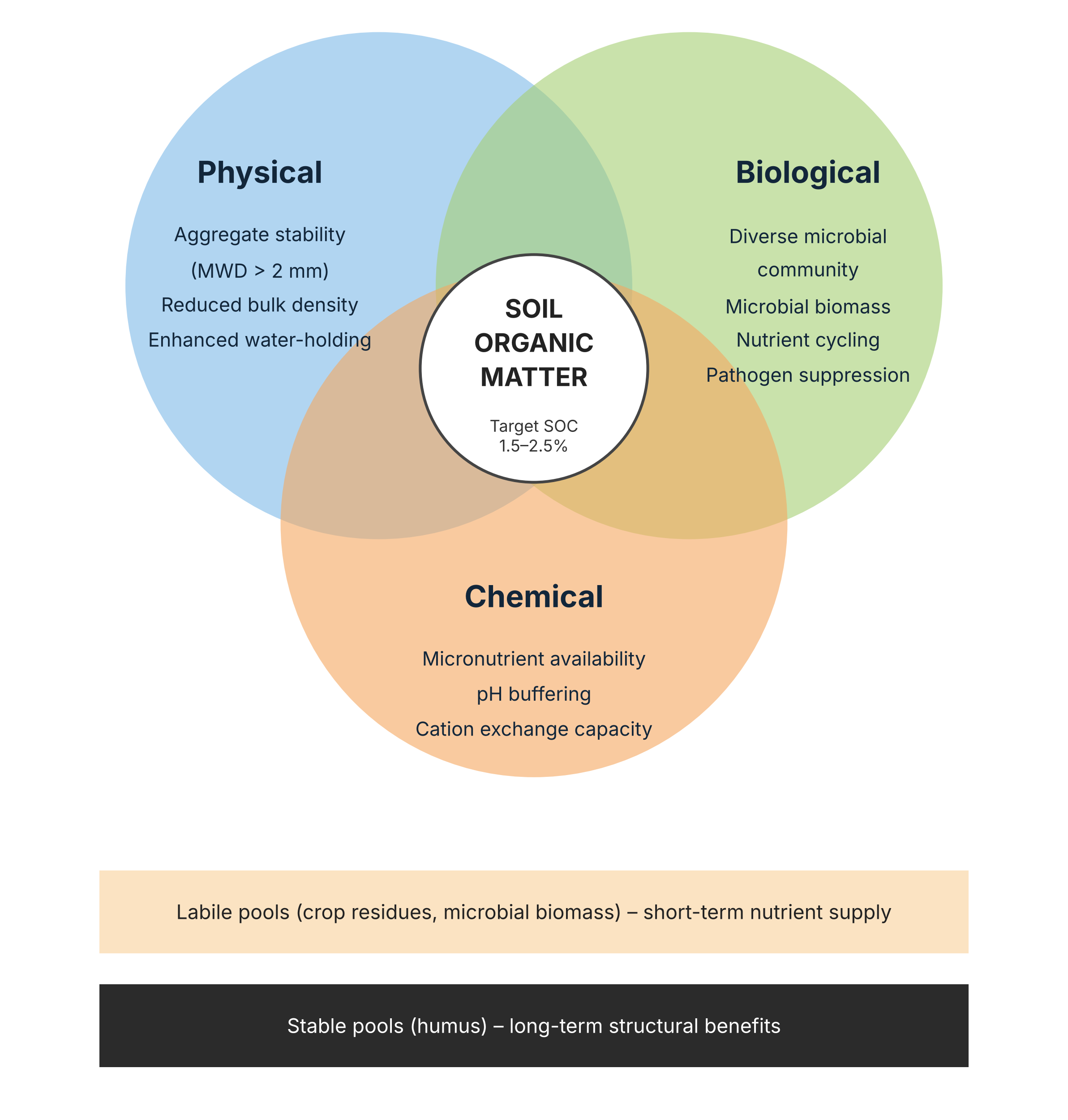
Soil organic matter (SOM) is a central integrating factor linking the physical, chemical, and biological dimensions of soil health. In vegetable production systems, where SOM turnover is rapid, continuous replenishment through organic inputs is essential. SOM comprises labile pools including crop residues and microbial biomass that provide short-term nutrient supply, and stable pools principally humus that confer long-term structural benefits (Lal 2020). The multifunctional benefits of SOM are depicted in Figure 1.
4.2 Target levels and monitoring
Long-term experiments demonstrate that maintaining Soil Organic Carbon (SOC) soils at levels that are beyond the critical levels is associated with increased yields and decreased reliance on synthetic inputs. General guidelines recommend minimum SOC levels of 1.5–2.5% of soil mass for intensive vegetable production, with higher values required in finer-textured soils, although a universal critical SOC threshold has not been established (Loveland and Webb 2003). Key monitoring indicators include total organic carbon, particulate organic matter (>53 m fraction, a biomarker of early activity), and microbial biomass carbon, a biomarker of active biological component.
5 Integrated management strategies
5.1 Organic amendments
5.1.1 Composts and manures
Well composted materials release nutrients evenly, improve the diversity of the microbes, improve the soil structure, and raise the disease suppressiveness. Application rates of 20–40 Mg compost ha-1 or 15-30 Mg manure ha-1 have been shown to increase SOC and vegetable yields relative to mineral fertilization alone (Diacono and Montemurro 2010; Gaskell and Smith 2007). The level of benefits depends critically on the quality of the compost as indicated by a C:N ratio of 15-25:1 and a maturity index of over 80% indicates good quality. The new considerations about organic amendments contamination with per- and polyfluoroalkyls (PFAS) and other recalcitrants compel the need to ensure quality very strictly, especially when using biosolids or composts based on municipal waste streams (Blaine et al. 2013; Bolan et al. 2021).
5.1.2 Biochar applications
One of the characteristics unique to biochar is high surface area and persistence that provide better water-retention and nutrient retention properties, particularly where the soil is sandy. However, it has a significant influence on the soil type, application rate (5-30 Mgha-1), soil type, and the pyrolysis temperature. Meta-analyses indicate an average yield increase of 10–25%, with the greatest benefits observed in acidic, sandy, or degraded soils and in tropical rather than temperate regions (Jeffery et al. 2017; Liu et al. 2013). The economic viability is a restrictive element to the large-scale implementation; the costs are between $1,000 and $6,000 per hectare, depending on volume of production, availability of feedstock and distance to market (Meyer et al. 2011; Roberts et al. 2010).
5.1.3 Integrated approaches
The combined use of organic amendments and mineral fertilizers produces synergistic effects; organic inputs enhance nutrient-use efficiency by 20–40%, while mineral nutrients stimulate organic matter decomposition by improving the synchrony between nutrient supply and crop demand (Vanlauwe et al. 2010). The different organic amendment its application rates, and management considerations are given in Table 2.
| Amendment type | Application rate | Primary benefits | Key considerations | Reference |
|---|---|---|---|---|
| Compost | 20-40 Mg ha-1 | Gradual nutrient release, enhanced microbial diversity, improved soil structure, increased disease suppressiveness | C:N ratio 15-25:1, maturity index >80%, screen for PFAS and contaminants | (Diacono and Montemurro 2010) |
| Animal manure | 15-30 Mg ha-1 | Higher nutrient content than compost, rapid SOC increase | Well-composted preferred to minimize pathogens and weed seeds; monitor N availability | (Gaskell and Smith 2007) |
| Biochar | 5-30 Mg ha-1 | Enhanced water retention, nutrient retention, long-term C sequestration; yield increase 10-25% in degraded soils | Effect varies with pyrolysis temperature, feedstock, soil type; high cost ($1,000-6,000 ha-1) | (Jeffery et al. 2017) |
| Cover crop residues | Biomass varies by species | N fixation (60-150 kg N ha-1 for legumes), erosion control, weed suppression, SOC increase 0.3 Mg C ha-1 year-1 | Proper species selection and termination timing critical to avoid cash crop competition | (Finney et al. 2016) |
| Organic + Mineral (integrated) | Combined application | Synergistic effects: 20-40% enhanced nutrient-use efficiency, optimized synchronization of supply and demand | Requires site-specific adjustment based on soil test and crop requirements | (Vanlauwe et al. 2010) |
5.2 Integrated soil fertility management
Integrated Soil Fertility Management (ISFM) combines organic resources, mineral fertilizers, enhanced germplasm and knowledge based decision support as per the local conditions (Vanlauwe et al. 2010). In intensive vegetable systems, ISFM deals with fast cycling of nutrients and the lack of synchrony between supply and demand.
5.2.1 Nitrogen management
The management of nitrogen needs specific consideration because of high crop demand (150-300 kgNha-1 season-1) which is concentrated within a limited time. Synchronizing nitrogen supply with crop uptake through split applications, controlled-release formulations, and combining organic-mineral sources improves efficiency by 25-50% while reducing losses (Zhu and Chen 2002; Sainju et al. 2002). The management of phosphorus fixation by means of strategic location, addition of organic matter to increase the solubility, and the association with mycorrhizae to promote its uptake (Rengel and Marschner 2005).
5.2.2 Biofertilizers
When used in combination with proper application, biofertilizers with nitrogen-fixing bacteria, phosphate-solubilizing microorganisms, and arbuscular mycorrhizal fungi can lower the need to use mineral fertilizers by 15-30 % and still get the same yield (Basu et al. 2021).
5.3 Crop rotation and cover cropping
5.3.1 Diversified rotations
Effective rotations span 3–5 years and should incorporate crops from distinct botanical families (e.g., Solanaceae, Fabaceae, Brassicaceae, Cucurbitaceae) with contrasting root architectures. Legume inclusion promotes biological nitrogen fixation; well-managed legume cover crops or green manures can supply 60-150 kg N ha-1 depending on legume species and growth period (Peoples et al. 2009; Thilakarathna et al. 2016). Root crops disruption of compaction layers. Rotations eliminate 40–70% of the number of soil-borne diseases compared to monoculture (Larkin 2015).
5.3.2 Cover crops
Cover crops maintain soil health during fallow periods. Legume cover crops fix atmospheric nitrogen, grass cover crops generate substantial biomass to improve structure, and brassica cover crops provide biofumigation against soil borne pathogens. Cover cropping increases SOC stocks by approximately 0.3 Mg C ha-1 year-1, raises microbial biomass by 20-50%, and can improve cash crop yields by 10–25% (Finney et al. 2016; Wortman et al. 2012; Poeplau and Don 2015). Effective implementation requires careful species selection, appropriate termination timing, and management practices that avoid competition with the subsequent cash crop.
5.4 Conservation tillage
Reduced tillage, strip tillage, and no-till techniques preserve soil structure, reduce oxidative loss of organic matter (by 30-60%), and conserve biological communities. Despite widespread success in field crops, conservation tillage has not been fully adapted to vegetable production owing to challenges with crop establishment, weed management, and soil warming requirements. Adapted approaches such as zone tillage, permanent bed systems, and mulch-based production can meet vegetable production requirements while improving soil health. Best results are achieved when these techniques are integrated with cover crop mulches and organic amendments, though a 2-4 year transition period should be anticipated during which yield fluctuations may occur before soil health benefits are fully realized (Carr et al. 2013; Teasdale et al. 2007).
6 Greenhouse and protected systems
Protected farming enables year-round farming, but it concentrates the issues of soil health. Continuous monoculture results in soil fatigue, also known as re-plant disease, and is characterized by yield reductions of 20-50%, reduced crop vitality, and elevated disease incidence despite adequate soil fertility. Contributing processes include the accumulation of allelopathic compounds, pathogen proliferation, and depletion of beneficial microorganisms (Gao et al. 2020; Huang et al. 2013).
6.1 Salinity accumulation
Salinity accumulates rapidly in protected systems owing to the absence of rainfall leaching, high fertilization rates (400-600 kg N ha-1 per year), and reduction of drainage, which leads to electrical conductivity often surpassing crop-specific tolerance thresholds (1.0–4.0 dS m-1) within 2- 3 years of operation, subjecting crops to progressive osmotic stress (Sonneveld and Voogt 2009).
6.2 Soil fatigue and disease management
The effective remediation methods include: (1) soil solarization whereby the moist soil is covered with transparent plastic wraps to 45-55°C during the summer months (4 to 6 weeks) which achieves 90 to 99 %reduction of pathogens in many soil-borne bacteria and fungi (Katan 2017; Stapleton 2000); (2) biofumigation using incorporated brassica residual materials; (3) grafting onto disease-resistant rootstocks. Biological methods such as the application of disease-suppressive compost (30–50 Mg ha-1) and microbial inoculants represent sustainable alternatives to chemical fumigation (Bonanomi et al. 2018).
Soilless production systems such as hydroponics and substrate culture eliminate soil-related constraints but require substantial infrastructure investment, with moderately to highly automated systems costing $ 50,000 - $150,000 ha-1 to establish (at 1995–2009 price levels), depending on climate control requirements, automation level, and the precision of nutrient solution management (Jensen and Malter 1995; Gruda 2009). Hybrid approaches combining in-soil management improvements with targeted soilless production represent promising options for optimized resource utilization.
7 Climate-smart and organic production
7.1 Organic systems
Certified organic systems prioritize biological processes and organic inputs, excluding synthetic fertilizers and pesticides. Evidence consistently shows that organic farming improves soil biological activity: microbial biomass is 30–60% greater and soil organic carbon is 0.3–0.8% higher than in conventional systems. Meta-analyses indicate that organic yields average approximately 75% of conventional yields, with the yield gap narrowing as soil health improves over time (Seufert et al. 2012; Ponisio et al. 2015; Reganold and Wachter 2016).
7.1.1 Adaptation and mitigation of climate change
Soil health-enhancing practices also build climate resilience. Improved soil structure and higher organic matter content increase water-holding capacity (providing 15–25% greater drought resistance), promote nutrient cycling efficiency, and facilitate soil carbon sequestration (estimated at 0.3-0.8 Mg C ha-1 year-1), promote nutrient cycling efficiency, and facilitate soil carbon sequestration (estimated at 0.3–0.8 Mg C ha-1 year-1), partially offsetting agricultural emissions (Paustian et al. 2016; Aguilera et al. 2013). However, net greenhouse gas balances must account for nitrous oxide emissions associated with nitrogen fertilization, which can offset 20–40% of the carbon sequestration benefit in intensive systems. Optimized nitrogen management through ISFM can reduce N2O emissions by 30–50% without yield penalty (Gu et al. 2023; Snyder et al. 2009). Climate change also threatens soil health through altered precipitation patterns driving leaching and erosion, elevated temperatures accelerating organic matter decomposition, and extreme weather events causing compaction and nutrient loss (Lal 2020).
8 Precision management and digital tools
Spatial variability in soil properties creates opportunities for site specific management. Precision agriculture technologies including soil sensors, remote sensing, and variable rate application equipment enable optimized input use. Reviews indicate that precision nutrient management can increase nitrogen use efficiency by 10-30% and reduce environmental losses (Mulla 2013; Zhang et al. 2002; Cambouris et al. 2014). Digital soil mapping, which integrates field measurements with environmental covariates to predict landscape-scale soil properties, supports targeted management decisions (Minasny et al. 2013).
Real-time soil monitoring through sensor networks provides decision support for irrigation and nutrient management. Nevertheless, high initial costs ($10,000–$50,000 for a basic precision agriculture system; (Schimmelpfennig 2016), data management complexity, and technical knowledge requirements limit accessibility, particularly for smallholder farmers who produce the majority of vegetables globally. Simplified decision-support tools, mobile applications, and farmer advisory services offer pathways to wider adoption, although their effectiveness across diverse contexts requires further validation.
9 Knowledge gaps and research priorities
Long-term monitoring: Very few experiments have recorded the soil-health dynamics of intensive vegetable rotations with periods longer than 10 years (representing less than 5% of the published literature) limiting understanding of threshold effects and long-term recovery trajectories. Establishing regional monitoring networks with standardized indicators would substantially advance this knowledge base.
Biological indicators: The composition of microbial communities and enzyme activities have potential to be sensitive measures of assessment, but normalization of such measures to allow routine monitoring and interpretation systems that would relate biological measurements to agronomic outputs needs to be developed. The practical uses are also limited due to current costs of analysis (between $200 and 500 per sample to perform all microbial analyses; (Lehman et al. 2015)).
Economic feasibility: Smallholder farmer economic studies are unsatisfactory. Although there exist general cost ranges, return-on-investment schedule, risk analysis and financing mechanism need thorough reviews. Particularly critical are analyses of transition periods where short-term yield penalties may occur before soil health benefits manifest.
Regional adaptation: The majority of studies are based on temperate systems; the frameworks of adaptation developed to tropical and subtropical conditions need to be developed, taking into consideration increased temperatures (faster decomposition of organic-matter), altered crop rotation, and alternative sources of organic amendments.
Emerging contaminants: Microplastic accumulation in agricultural soils represents an emerging concern, particularly in intensive vegetable systems using plastic mulches, drip irrigation, and greenhouse covers (Rillig et al. 2021; Qi et al. 2018). Research on the effects of microplastics on the physical characteristics of soil, the community of microorganisms, and the uptake of vegetable crops is needed. Equally, the routes of PFAS contamination and its build up in vegetable crops must be studied on a systematic basis (Blaine et al. 2013).
Process-based modeling: Theoretical frameworks to connect the biological communities of soil to nutrient cycling, as well as crop performance, would allow better predictive management, but parameterization and validation is still difficult.
10 Policy and implementation pathways
10.1 Policy interventions
Policies should incorporate soil-health indicators into agricultural subsidy programmes and certification schemes, including minimum SOC thresholds for labels such as “sustainably produced” and “climate-smart.” Financial incentives are essential to offset transition costs, estimated at $500–$2,000 ha-1 over the first three years, based on typical costs of compost application and cover crop establishment (Carlisle 2016). Payment for ecosystem services schemes, which compensate farmers for carbon sequestration and water quality improvements, hold considerable potential but require standardized monitoring and verification protocols.
10.2 Extension services
Effective extension services require investment in farmer training programmes, demonstration plots showcasing integrated soil-health practices, and advisory services capable of providing site-specific recommendations. Digital platforms and mobile applications can extend the reach of these services, though language, literacy, and connectivity barriers must be carefully addressed to ensure equitable access. Notable examples include the Indian Soil Health Card programme, which served over 100 million farmers between 2015 and 2020 (Government of India 2020), and California extension programmes that integrate soil-health considerations within Integrated Pest Management frameworks.
10.3 Farmer networks
Farmer networks are composed of peer-to-peer knowledge exchange, producer organisations and participatory research consortia that can facilitate social learning and practices specific to localities. Empirical data shows that interventions that are spread through networks of farmers have an adoption rate at least two to three times higher than that obtained with traditional top-down methods of extension (Kroma 2006; Gliessman 2015).
11 Conclusion
Soil health is the cornerstone of sustainable and productive vegetable production systems capable of meeting growing global demand while protecting environmental integrity. Intensive production generates substantial pressures that necessitate proactive, integrated management of physical, chemical, and biological soil properties. Soil organic matter serves as the principal integrating factor, fostering positive feedbacks across all soil health dimensions when maintained at appropriate levels through consistent organic inputs.
Effective management integrates organic amendments, ISFM, crop rotation, cover cropping, and conservation tillage tailored to local environmental and agronomic conditions. Protected cultivation systems demand particular attention, requiring coordinated biological, physical, and chemical remediation strategies. Precision technologies offer considerable promise for optimizing management, but accessibility barriers particularly for smallholder farmers require sustained innovation and institutional support. Realizing the full potential of soil health interventions requires coordinated action across policy, research, extension, and farming community levels.
By recognizing soils as living ecosystems that require active, evidence based stewardship, vegetable production systems can achieve sustainable intensification and contribute meaningfully to climate change mitigation, with an estimated carbon sequestration potential of 0.3–0.8 Mg C ha-1 year-1, water quality protection through a 50–70% reduction in nitrate leaching via optimized nitrogen management, and biodiversity conservation.
Artificial intelligence (AI) tools were used solely for grammatical correction and language improvement. The authors reviewed and verified all content and take full responsibility for the accuracy and integrity of the manuscript.
References
Publication Information
- Submitted: 02 February 2026
- Accepted: 27 October 2026
- Published (Online): 28 October 2026
Reviewer Information
Reviewer 1:
Dr. Tirivashe Phillip Masere
Deputy Dean - Faculty of Agriculture
Midlands State UniversityReviewer 2:
Anonymous
The statements, opinions and data contained in all publications are solely those of the individual author(s) and contributor(s) and not of the publisher and/or the editor(s).
The publisher and/or the editor(s) disclaim responsibility for any injury to people or property resulting from any ideas, methods, instructions or products referred to in the content.
© Copyright (2026): Author(s). The licensee is the journal publisher. This is an Open Access article distributed under the terms of the Creative Commons Attribution-NonCommercial-NoDerivatives 4.0 International License, which permits non-commercial use, sharing, and reproduction in any medium, provided the original work is properly cited and no modifications or adaptations are made.