Surveillance of Pesticide Residues in Marketed Tender Coconut from Southern India
Pesticide residues were analysed in tender coconut (n = 85) samples collected from street vendors across four southern states of India - Kerala, Goa, Karnataka and Tamil Nadu - during 2025-26. Both tender coconut water and meat were subjected to multi-residue analysis using the modified QuEChERS extraction method with LC-MS/MS and GC-MS. Pesticide residues were detected in 12.94 per cent of samples. Read more …

Pesticide residues were analysed in tender coconut (n = 85) samples collected from street vendors across four southern states of India - Kerala, Goa, Karnataka and Tamil Nadu - during 2025-26. Both tender coconut water and meat were subjected to multi-residue analysis using the modified QuEChERS extraction method with LC-MS/MS and GC-MS. Pesticide residues were detected in 12.94 per cent of samples. Monocrotophos, an organophosphorus compound, was detected in coconut water at levels of 0.012 to 0.026 mg kg-1 and in the meat at 0.005 to 0.027 mg kg-1, in samples from Alappuzha, Palakkad, Kollam, Kannur and Ernakulam districts in Kerala. Imidacloprid, a neonicotinoid, was found in tender coconut water at levels of 0.003 to 0.0051 mg kg-1 from Kannur and Thrissur districts of Kerala, and in the meat at 0.012 mg kg-1 from Gundlupet, Karnataka. One sample contained multiple residues, with both monocrotophos and imidacloprid detected simultaneously. Comparison of the detected residue levels with Codex maximum residue limits (MRLs), or EU MRLs where Codex limits were unavailable, revealed that three samples contained pesticide residues exceeding the applicable MRLs numerically. These findings indicate the occurrence of pesticide residues in tender coconut and highlight the need for continued residue monitoring to support food safety and regulatory decision-making, particularly in view of the absence of commodity-specific MRLs for tender coconut under FSSAI regulations.
QuEChERS, monocrotophos, imidacloprid, LOQ, LC-MS/MS, GC-MS
1 Introduction
Tender coconut, the immature fruit of Cocos nucifera L., is widely consumed as a natural health beverage because of its rich composition of electrolytes, sugars, amino acids, vitamins and bioactive compounds (Yong et al. 2009). Beyond its health attributes, coconut holds considerable agricultural and economic significance globally. According to the Food and Agriculture Organisation (FAOSTAT 2024), global coconut production exceeds 62 million tonnes annually, with India ranking among the top producers at approximately 14.70 million tonnes. Tender coconut, in particular, constitutes an increasingly important segment of the coconut economy, with an estimated 12-15% of India’s total coconut production utilised as tender nuts, driven by rising demand for packaged tender coconut water in both domestic and international markets (Coconut Development Board 2023; Lijeesh 2024). Unlike copra, oil or other processed coconut products, tender coconut is consumed directly from the nut with little or no intervening treatment, and it is marketed and perceived by consumers as a “pure,” minimally processed drink (Jonnalagadda et al. 2022). Any agrochemical residue present in the palm or the developing fruit therefore reaches the consumer largely unaltered, making tender coconut a particularly sensitive commodity from a food-safety standpoint.
Despite its economic importance, coconut cultivation faces persistent threats from a wide range of insect pests, with over 900 species recorded as damaging agents, collectively responsible for crop losses of up to 30% (Kumara et al. 2015). Among the most economically significant are the rhinoceros beetle (Oryctes rhinoceros), the red palm weevil (Rhynchophorus ferrugineus), the eriophyid mite (Aceria guerreronis), and the black-headed caterpillar (Opisina arenosella), all of which cause substantial damage to the palm and its produce (Chowdappa and Singh 2016; Abhishek and Dwivedi 2021). To manage these pests, farmers frequently rely on insecticides such as chlorpyriphos, imidacloprid, monocrotophos and other systemic organophosphate, carbamate, and neonicotinoid compounds. However, improper pesticide application, failure to follow Good Agricultural Practices (GAP) and off-label usage of pesticides can result in the accumulation of residues in the edible agricultural commodities, raising concerns about consumer safety (Kariyanna et al. 2024).
Pesticide residues in food are not a concern unique to coconut. They represent a recurring global challenge for public health and food trade. At a global scale, pesticide consumption has continued to rise, with FAO figures placing total use above 2.5 million tonnes in 2020 alone, underscoring the scale of the residue monitoring challenge facing food systems generally (El-Sheikh et al. 2023). Chronic dietary exposure to pesticide residues has been linked to a range of adverse health outcomes, including neurotoxic, endocrine-disrupting and reproductive effects, particularly where produce is consumed fresh and without further processing (Beyuo et al. 2024). Even trace level contamination can restrict market access for affected commodities, making residue surveillance a matter of both health and trade significance (Kariyanna et al. 2024).
Despite the widespread consumption of tender coconut, information on insecticide residues in this commodity is limited. The lack of commodity-specific residue data poses significant challenges for risk assessment and effective regulatory enforcement. Addressing this data gap is therefore essential to safeguard public health. In this context, the present study was conducted to determine the presence and levels of pesticide residues in tender coconut samples collected from street vendors across four southern states of India using multi-residue analytical methods.
2 Materials and methods
A market-monitoring study on pesticide residues in tender coconut was conducted from November 2025 to April 2026. A total of 85 tender coconut samples were collected through random sampling from street vendors across four states of southern India, namely Kerala, Goa, Karnataka and Tamil Nadu. The state- and district-wise distribution of the samples is summarised in Table 1. Samples were purchased fresh, water and meat were separated and packed in pre labelled PET bottles and zip-lock bags, respectively, and transported to the Pesticide Residue Research and Analytical Laboratory (PRRAL), College of Agriculture, Vellayani, under ice-packed conditions on the same day for analysis.
| Sl. No. | State | District | Samples | Matrices |
|---|---|---|---|---|
| 1 | Kerala | Thiruvananthapuram, Kollam, Pathanamthitta, Kottayam, Idukki, Alappuzha, Ernakulam, Thrissur, Palakkad, Malappuram, Kozhikode, Kannur, Wayanad, Kasargod | 70 | Water & Meat |
| 2 | Karnataka | Chamarajanagar | 8 | Water & Meat |
| 3 | Goa | South Goa | 5 | Water & Meat |
| 4 | Tamil Nadu | Dindigul | 2 | Water & Meat |
| TOTAL | 85 |
2.1 Chemicals and reagents
The analytical standards (technical, \(≥\) 95% purity) of 105 pesticides analysed were received from HPC Standards GmbH. Methanol of LC-MS grade (Optima) was procured from M/s. Fisher chemicals, GC-MS grade n-hexane was procured from J.T.Baker® and acetonitrile (HPLC Grade), sodium chloride, anhydrous sodium sulphate and anhydrous magnesium sulphate of GR grade were purchased from Merck Specialities Private Limited, Mumbai and the solid reagents were activated before use. Primary secondary amine (PSA) sorbent was purchased from M/s. Agilent Technologies, Palo Alto, CA. The suitability of solvents and other chemicals was ensured by running reagent blanks before actual analysis.
2.2 Preparation of standard pesticide mixture
Stock solutions (1000 mg L-1) of LC mix were prepared by dissolving a weighed quantity of the analytical grade material of monocrotophos, carbamates and new molecules in HPLC-grade methanol. The stock solutions were serially diluted to prepare an intermediate stock of 100 mg L-1. The intermediate stock solutions were further diluted with HPLC-grade methanol to prepare working standard pesticide mixtures (10 mg L-1) for residue quantification using LC-MS/MS by positive electrospray ionisation. The working standard mixtures were then serially diluted to obtain 0.50, 0.10, 0.075, 0.05, 0.025, and 0.01 mg L-1 concentrations of analytical-grade pesticides.
A stock solution (400 mg L-1) of GC mix was prepared by dissolving a weighed amount of approximately 10 mg each of Certified Reference Material (CRM) of pesticides belonging to organochlorines, organophosphates and synthetic pyrethroids in a minimal quantity of HPLC-grade acetone, followed by dilution with a 1:1 mixture of n-hexane and toluene. From this primary stock solution, a working standard with a concentration of 10 mg L-1 was prepared. To achieve this, 0.625 mL of GC mix (400 mg L-1) was transferred to separate volumetric flasks, and the final volume was adjusted with n-hexane. These solutions were serially diluted to lower concentrations of 0.50, 0.25, 0.10, 0.075, and 0.05 mg L-1 for further analysis.
2.3 Sample preparation
Pesticide residues in tender coconut water and meat were extracted following a modified QuEChERS method. For water, 10 mL of sample was taken in a 50 mL centrifuge tube, to which 20 mL of acetonitrile, 4 g of sodium chloride (NaCl), and 1 g of anhydrous magnesium sulphate (MgSO4) were added and vortexed for 1 min, followed by centrifugation at 6000 rpm for 10 min at 8°C. 12 mL of the supernatant was transferred to a dispersive-SPE tube containing 0.05 g primary secondary amine (PSA) and 0.6 g MgSO4, vortexed for 30 sec, and centrifuged at 3000 rpm for 10 min at 8°C.
For the tender coconut meat, 15 g of blended sample was homogenised with 30 mL acetonitrile at 14,000 rpm for 2 min, followed by the addition of 6 g NaCl and centrifugation at 8000 rpm for 8 min at 8°C. 16 mL of the supernatant was collected, treated with 6 g anhydrous sodium sulphate (Na2SO4), and vortexed for 1 min. 12 mL of this extract was subjected to dispersive Solid Phase Extraction (SPE) using 0.2 g PSA and 1.2 g MgSO4, vortexed for 30 sec, and centrifuged at 4500 rpm for 5 min at 8°C.
In both cases, the cleaned extracts were evaporated to dryness under a nitrogen stream using a Turbovap at 45°C and reconstituted as follows: 5 mL in 1 mL methanol and 5 mL in 1 mL n-hexane for water, and 3 mL in 1.5 mL methanol and 4 mL in 1 mL n-hexane for meat - for LC and GC analysis, respectively. The detection was carried out through the GC and LC techniques as prescribed in the Pesticide Residue Analysis Manual of ICAR (Sharma 2013).
2.4 Instrumentation
2.4.1 GC-FPD
Residue estimation of organophosphates was done using gas chromatography (Shimadzu 2010 AT) with a flame photometric detector (FPD). The target compounds were separated using a DB-5 capillary (30 m × 0.25 mm × 0.25 \(µ\)m film thickness) column with nitrogen as the carrier gas. Zero air and hydrogen were used to generate the flame. Operating conditions of GC were as follows: column flow (1 mL min-1), injector temperature (250°C), detector temperature (280°C), and column oven temperature programmed between 170 - 270°C @ 3.5°C. Residue confirmation was performed using GC–MS (Shimadzu GC–MS QP 2010 Plus), operated with helium as the carrier gas and Electron Impact Ionization at 70 eV.
2.4.2 GC-ECD
Residue estimation of organochlorines and synthetic pyrethroids was performed using gas chromatography (Shimadzu 2010 AT) equipped with an Electron Capture Detector (ECD). Operating conditions of GC were as follows: column, DB-5 capillary (30 m × 0.25 mm × 0.25 \(µ\)m film thickness), carrier gas - nitrogen, column flow - 0.79 mL min-¹, injector temperature - 250°C and detector temperature used was 300°C. The residues of pesticides were confirmed by GC-MS (Shimadzu GC-MS QP 2010 Plus). Helium was used as the carrier gas in GC-MS operated with Electron Impact Ionization (70 eV). Injector temperature, column, and column flow were similar in both GC and GC-MS.
2.4.3 LC-MS/MS
Residue estimation of monocrotophos, carbamates and new molecules was performed using liquid chromatography-tandem mass spectrometry (LC-MS/MS). The chromatographic separation was achieved in reversed-phase mode by using Waters Acquity Ultra Performance Liquid Chromatography (UPLC) system equipped with Waters Atlantis dC-18 (100 mm x 2.1 mm, 5\(µ\)m particle size) column. The gradient system included the following eluent compounds, which were used as mobile phase for the separation of residues, viz., (A) 10% methanol in water + 0.1% formic acid + 5 mM ammonium acetate and (B) 10% water in methanol + 0.1% formic acid + 5 mM ammonium acetate. The gradient elution was 0 min isocratic 20% B, increased to 90% B in 4 min, then raised to 95% B in 5 min, increased to 100% B in 9 min, then decreased to the initial composition of 20% B in 10 min and held for 12 min for re-equilibration. The injection volume was 10 \(µL\), and the flow rate was constant at 0.8 mL min-1. The temperature of the column was maintained at 40°C. The effluent from the LC system was introduced into a triple quadrupole API 3200 MS/MS system equipped with an electrospray ionization interface (ESI), operating in the positive ion mode. The source parameters were temperature 600°C, ion spray voltage 5500 V, ion gas (GSI) 50 psi, ion gas (GS2) 60 psi and curtain gas 13 psi.
2.5 Method validation
The methods for analysing pesticide residues of 105 pesticides were validated in accordance with AOAC 20th Edition, 2016: Chapter 10, method 2007.01 SANTE/11312/2021 guidelines, and the European Union Reference Laboratory multi-residue method, ensuring that all validation parameters, including accuracy, precision, repeatability and reproducibility, were within acceptable limits prior to the real sample analysis.
2.6 Determination of Limit of Detection (LOD)
Under set standard instrument conditions, 10 \(µL\) of each working standard (0.50, 0.10, 0.075, 0.05, 0.025 and 0.01 mg L-1) was injected into the instrument. Each standard was injected three times. LOD is the lowest concentration of pesticide that could be detected under standard conditions. Based on that, the instrument’s LOD was calculated for each pesticide. The minimum concentration with a signal-to-noise ratio (S/N) $≥$3 is considered the limit of detection (LOD).
2.7 Determination of Limit of Quantification (LOQ)
The limit of quantitation (LOQ) is the lowest concentration of a target molecule that can be consistently detected and quantified with a specific level of accuracy and precision. It is the minimum concentration with a signal-to-noise ratio (S/N) \(≥\) 10.
2.8 Linearity
The linearity of the calibration curve was calculated based on the injection of standard solution at LOQ level was assessed by the chromatogram area corresponding to the lowest fortified level.
2.9 Determination of recovery and repeatability
Recovery experiment was conducted for evaluating accuracy and precision of method, for which samples at three spiked concentration levels at 0.01, 0.05 and 0.1 mg kg−1 levels with three replications were extracted. The spiked sample was obtained by adding the appropriate volume of the standard solution mixture of the pesticides, to the homogenized sample before extraction. Samples were extracted, residues were quantified, confirmed and the precision of the method was evaluated by measuring the relative standard deviations (RSDs).
3 Results
The analytical method for the determination of insecticide residues in tender coconut water and meat was validated in accordance with SANTE/11312/2021 guidelines (SANTE, 2021). The Limit of Quantification (LOQ) was established as 0.01 mg kg-1 for all insecticides analysed by both GC-MS and LC-MS/MS. Strong linearity was observed over the evaluated working concentration range. The repeatability of the method was assessed at multiple fortification levels, including the LOQ and its multiples (5 X LOQ and 10 X LOQ). The mean percentage recoveries for all spiked insecticides ranged from 71.60-114.00 per cent in tender coconut water and from 72.50-115.33 per cent in coconut meat, which were within the internationally accepted limits of 70-120 per cent. The Relative Standard Deviation (RSD) values were below 20 % at all fortification levels. All validation parameters, including LOD, LOQ, linearity, recovery and repeatability, met the required standards, confirming the suitability of the method for monitoring of insecticide residues in tender coconut water and meat (Table 2; Table 3).
| Sl. No. | Parameters | Organochlorine Pesticides | Organophosphorus Pesticides | Synthetic Pyrethroid Pesticides | Carbamates | New Molecules |
|---|---|---|---|---|---|---|
| 1 | Linearity | 0.9925–0.9957 | 0.9911–0.9931 | 0.9905–0.9975 | 0.9910–0.9951 | 0.9913–0.9954 |
| 2 | Limit of Detection (LOD) (mg kg-1) | 0.003 | 0.003 | 0.003 | 0.003 | 0.003 |
| 3 | Limit of Quantification (LOQ) (mg kg-1) | 0.01 | 0.01 | 0.01 | 0.01 | 0.01 |
| 4 | Accuracy (%) | 77.80–114.00 | 74.60–113.00 | 71.60–108.10 | 82.50–105.20 | 78.50–113.30 |
| 5 | Precision (%) | 9.80–18.50 | 3.30–17.70 | 6.50–18.20 | 3.06–12.40 | 5.39–13.19 |
| Sl. No. | Parameters | Organochlorine Pesticides | Organophosphorus Pesticides | Synthetic Pyrethroid Pesticides | Carbamates | New Molecules |
|---|---|---|---|---|---|---|
| 1 | Linearity | 0.9921–0.9960 | 0.9931–0.9966 | 0.9910–0.9975 | 0.9912–0.9959 | 0.9916–0.9973 |
| 2 | Limit of Detection (LOD) (mg kg-1) | 0.003 | 0.003 | 0.003 | 0.003 | 0.003 |
| 3 | Limit of Quantification (LOQ) (mg kg-1) | 0.01 | 0.01 | 0.01 | 0.01 | 0.01 |
| 4 | Accuracy (%) | 72.50–106.30 | 82.00–111.33 | 73.80–104.50 | 75.75–90.00 | 76.06–115.33 |
| 5 | Precision (%) | 8.74–16.60 | 5.12–19.40 | 7.78–18.20 | 3.40–19.24 | 5.58–15.90 |
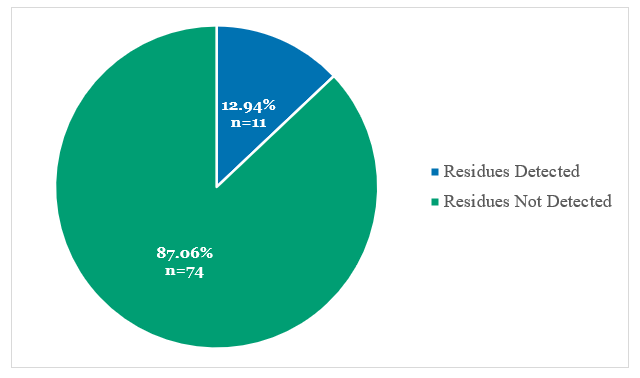
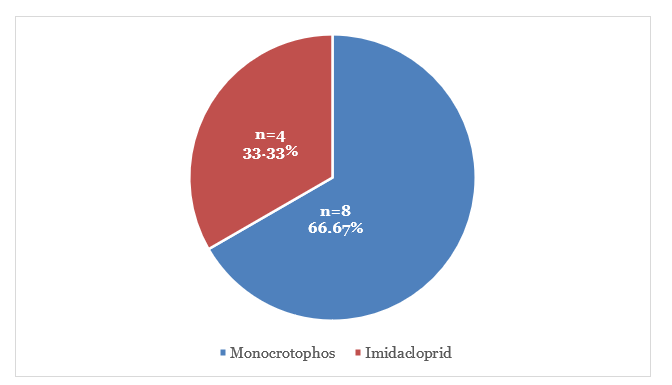
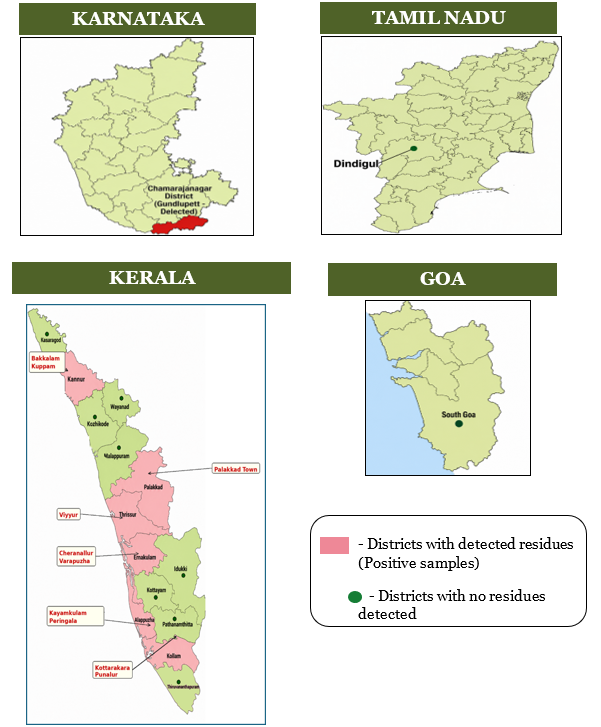
Out of 85 market samples of tender coconut analysed, pesticide residues were detected in 11 samples (12.94 %) (Figure 1). A total of two pesticides belonging to different chemical groups were detected, namely monocrotophos (organophosphate) and imidacloprid (neonicotinoid). Monocrotophos was the most frequently detected pesticide, occurring in 8 samples, corresponding to a detection frequency of 9.41 per cent. The residue concentration of monocrotophos in tender coconut water ranged from 0.012 – 0.026 mg kg-1 whereas in the coconut meat the residues ranged from 0.005 to 0.027 mg kg-1. Imidacloprid was detected in 4 samples, with a detection frequency of 4.70 per cent. The residue levels in tender coconut water ranged from 0.003 to 0.0051 mg kg-1, while a residue level of 0.012 mg kg-1 was detected in the coconut meat. One sample contained multiple residues, with both monocrotophos and imidacloprid detected in the same sample. The details of pesticides detected from the market samples are provided in Table 4 (Figure 3). Among the positive samples, residues were detected in the coconut water of four samples, the meat of three samples, and both the coconut water and the meat of four samples. Comparison of the detected residue levels with the prescribed Codex/EU Maximum Residue Limits (MRLs) revealed that three samples contained pesticide residues exceeding the prescribed MRLs numerically (Table 5). These included imidacloprid in tender coconut meat from Gundlupet, Karnataka (0.012 mg kg-1; MRL: 0.01 mg kg-1), monocrotophos in tender coconut water from Kayamkulam (0.021 mg kg-1; MRL: 0.02 mg kg-1) and monocrotophos in tender coconut water (0.026 mg kg-1) and meat (0.027 mg kg-1) from Cheranellur (MRL: 0.02 mg kg-1) (Table 5).
| Insecticide | Group | Matrix | Range (mg kg-1) | Location |
|---|---|---|---|---|
| Monocrotophos | Organophosphorus | TCW | 0.012–0.026 | Kayamkulam, Peringala, Palakkad Town, Kottarakara, Kuppam, Varapuzha, Cheranallur (Kl) |
| Monocrotophos | Organophosphorus | TCM | 0.005–0.027 | Kayamkulam, Peringala, Kottarakara, Punalur, Varapuzha, Cheranallur (Kl) |
| Imidacloprid | Neonicotinoid | TCW | 0.003–0.0051 | Viyyur, Bakkalam, Kuppam (Kl) |
| Imidacloprid | Neonicotinoid | TCM | 0.012 | Gundlupet (Ka) |
| Sl. No. | Sampling Location | Insecticide | Matrix | Residue Detected (mg kg⁻¹) | CODEX MRL (mg kg⁻¹) | EU MRL (mg kg⁻¹) | Below/Above MRL |
|---|---|---|---|---|---|---|---|
| 1 | Gundlupet, Karnataka | Imidacloprid | TCM | 0.012 | 0.01 | 0.01 | Above |
| 2 | Palakkad Town | Monocrotophos | TCW | 0.012 | – | 0.02 | Below |
| 3 | Kayamkulam, Alappuzha | Monocrotophos | TCW | 0.021 | – | 0.02 | Above |
| Monocrotophos | TCM | 0.012 | – | 0.02 | Below | ||
| 4 | Peringala, Alappuzha | Monocrotophos | TCW | 0.018 | – | 0.02 | Below |
| Monocrotophos | TCM | 0.007 | – | 0.02 | Below | ||
| 5 | Cheranallur, Ernakulam | Monocrotophos | TCW | 0.026 | – | 0.02 | Above |
| Monocrotophos | TCM | 0.027 | – | 0.02 | Above | ||
| 6 | Varapuzha, Ernakulam | Monocrotophos | TCW | 0.016 | – | 0.02 | Below |
| Monocrotophos | TCM | 0.016 | – | 0.02 | Below | ||
| 7 | Kottarakara, Kollam | Monocrotophos | TCM | 0.005 | – | 0.02 | Below |
| 8 | Punalur, Kollam | Monocrotophos | TCM | 0.017 | – | 0.02 | Below |
| 9 | Viyyur, Thrissur | Imidacloprid | TCW | 0.003 | 0.01 | 0.01 | Below |
| 10 | Kuppam, Kannur | Monocrotophos | TCW | 0.005 | – | 0.02 | Below |
| Imidacloprid | TCW | 0.0051 | 0.01 | 0.01 | Below | ||
| 11 | Bakkalam, Kannur | Imidacloprid | TCW | 0.005 | 0.01 | 0.01 | Below |
4 Discussion
The present study revealed the occurrence of pesticide residues in tender coconut, with monocrotophos and imidacloprid being the compounds detected among the 105 pesticides screened. The detection of only two insecticides reflects the residue profile of the samples analysed. Variations in pesticide-use practices and pesticide persistence across locations may account for the observed pattern. Monocrotophos, a systemic organophosphate insecticide, was detected in tender coconut water and meat collected from the Kerala districts of Ernakulam, Kollam, Palakkad and Alappuzha. The occurrence of monocrotophos residues in both matrices is consistent with the systemic nature of the compound and suggests that, following uptake, the insecticide may be translocated within the palm and subsequently reach the developing coconut tissues. Such movement is particularly possible when insecticides are applied through trunk injection or root feeding. These application methods have been used for the management of important coconut pests, including the red palm weevil (Rhynchophorus ferrugineus), rhinoceros beetle (Oryctes rhinoceros) and eriophyid mite (Aceria guerreronis)(Faleiro 2006; Tamil Nadu Agricultural University 2026). Previous studies have demonstrated the translocation of monocrotophos following trunk injection and its subsequent occurrence in different tissues of the coconut palm, including developing nuts and coconut water (Ranasinghe et al. 2003). The persistence of residues in young tender coconuts for several weeks following application has also been reported, indicating that systemic insecticide application can result in residues reaching edible portions of the fruit(Ranasinghe et al. 2003). However, as the samples in the present study were collected from street vendors, the source and pesticide application history of the coconuts could not be verified. Thus, the occurrence of monocrotophos in both matrices may be consistent with systemic translocation, but a specific application route or source of contamination cannot be established from the present monitoring data.
Imidacloprid, a systemic neonicotinoid insecticide, was detected in tender coconut water from Kannur and Thrissur districts in Kerala and in meat sample from Gundlupet, Karnataka. Its detection in both matrices across the surveyed samples is consistent with its systemic properties and capacity for translocation within plant tissues following uptake. However, the occurrence of residues in different samples does not establish a common pathway of distribution between the two matrices. The variation in residue occurrence may reflect differences in pesticide exposure, uptake and distribution among individual palms and fruits.
As specific FSSAI MRLs were not available for the pesticide-commodity combinations detected in the present study, Codex MRLs were used where applicable and in the absence of a Codex MRL, the corresponding European Union MRL was considered for comparison. When the positive samples were compared with the applicable Codex and European Union MRLs, three of the sixteen positive samples exceeded the corresponding reference limits numerically. These comprised one sample containing imidacloprid in the meat at 0.012 mg kg-1 against the Codex MRL of 0.01 mg kg-1 and two samples containing monocrotophos, one in tender coconut water alone and one in both water and meat, at concentrations of approximately 0.021 and 0.026-0.027 mg kg-1, respectively, compared with the EU MRL of 0.02 mg kg-1. Thus, although exceedances occurred only in a small proportion of the positive samples, their occurrence demonstrates that insecticide residues in tender coconut can occasionally approach or exceed internationally established tolerance levels. This finding is particularly relevant to commodities intended for domestic consumption and export, especially packaged tender coconut water, where compliance with importing-country residue requirements is essential.
Comparison with previously published studies provides further context for the occurrence of monocrotophos in tender coconut. (Paranthaman and Kumaravel 2013) reported monocrotophos at 5.847 mg kg-1 in tender coconut water of the Malayan Orange variety from southern Tamil Nadu, a concentration considerably higher than that observed in the present investigation. (Deme et al. 2013) subsequently validated an LC–ESI–MS/MS method for the determination of organophosphorus pesticide residues, including monocrotophos, in tender coconut water and emphasised the importance of regular residue surveillance in this commodity. In contrast, (Navyaja and Ramya Kuber 2018) detected monocrotophos at 0.00195 mg kg-1 in retail tender coconut water samples from the Tirupati region, a concentration substantially lower than that reported by (Paranthaman and Kumaravel 2013). More recently, (Jonnalagadda et al. 2022) detected monocrotophos, together with malathion, in 6 per cent of fresh and 4 per cent of packaged tender coconut water samples collected from Andhra Pradesh, Kerala and Tamil Nadu, with concentrations ranging from 1.00 to 51.60 \(µ\)g L-1. In the present investigation, monocrotophos was detected in 7.05 per cent of tender coconut water samples. Although the detection frequency was slightly higher than that reported by (Jonnalagadda et al. 2022), the concentrations observed in the present study were within a broadly comparable range. Collectively, these findings indicate that monocrotophos contamination in tender coconut water is sporadic but has been documented across different geographical regions and sampling periods.
The continued detection of monocrotophos is particularly noteworthy in view of its regulatory status in India. Monocrotophos has been prohibited for use on vegetable crops in India since 2005 (Ministry of Agriculture 2005), and its 36% soluble liquid (SL) formulation has subsequently been subjected to phased withdrawal (Ministry of Agriculture and Farmers Welfare 2023). Nevertheless, its detection in coconut samples suggests that the compound may still be used in some coconut-growing areas. The absence of a current CIB&RC label claim for monocrotophos use in coconut further raises concerns regarding potential off-label or non-recommended application (Central Insecticide Board and Registration Committee 2026). Taken together, the findings highlight a potential discrepancy between recommended insecticide-use practices and insecticide occurrence in marketable coconut products, emphasising the importance of grower awareness, adherence to approved insecticide recommendations and residue surveillance.
The findings of the present study therefore have implications beyond food safety and are relevant to sustainable pest management in coconut. Residue monitoring can complement integrated pest management (IPM) by providing information that supports more judicious use of chemical control. Preventive, cultural and biological approaches should be prioritised wherever feasible, with pesticides used only when necessary for effective pest management. When chemical intervention is required, pesticide selection and application should be guided by the pest situation, approved uses, recommended doses and appropriate timing. Adherence to good agricultural practices (GAP) and appropriate pre-harvest intervals can further help minimise unnecessary pesticide residues while maintaining effective pest control.
The detection of monocrotophos and imidacloprid in market samples, together with the exceedance of international reference limits in a few samples, emphasises the importance of incorporating residue considerations into coconut pest-management practices. Such an approach can support consumer safety and residue compliance while promoting responsible pesticide use, environmental protection and the sustainable production of quality tender coconut for domestic and export markets.
5 Conclusion
The present study developed and validated a multi-residue analytical method for the determination of pesticide residues in tender coconut water and meat. Among the sampled market tender coconuts, pesticide residues were detected in 12.94% of the samples, with monocrotophos and imidacloprid being the only residues identified. Their detection across multiple sampling locations, together with three samples exceeding international reference limits, underscores the importance of continued surveillance. Regular monitoring of pesticide residues in tender coconut, along with adherence to recommended pesticide-use practices, is therefore essential to ensure consumer safety and support the quality and marketability of tender coconut and its products.
Artificial intelligence (AI) tools were used solely for grammatical correction and language improvement. The authors reviewed and verified all content and take full responsibility for the accuracy and integrity of the manuscript.
References
Publication Information
- Submitted: 08 September 2026
- Accepted: 11 October 2026
- Published (Online): 15 October 2026
Reviewer Information
Reviewer 1:
Dr. Sankarganesh E
Assistant Professor
Bihar Agricultural UniversityReviewer 2:
Dr. Dhanapal R
Associate Professor
Mother Terasa College of Agriculture
The statements, opinions and data contained in all publications are solely those of the individual author(s) and contributor(s) and not of the publisher and/or the editor(s).
The publisher and/or the editor(s) disclaim responsibility for any injury to people or property resulting from any ideas, methods, instructions or products referred to in the content.
© Copyright (2025): Author(s). The licensee is the journal publisher. This is an Open Access article distributed under the terms of the Creative Commons Attribution-NonCommercial-NoDerivatives 4.0 International License, which permits non-commercial use, sharing, and reproduction in any medium, provided the original work is properly cited and no modifications or adaptations are made.