
From Detection to Action: Smart Technologies for Precision Weed Management
Precision weed management is evolving from uniform herbicide application toward intelligent, site-specific crop protection. This review examines smart sensing, deep learning, prescription mapping and precise spray delivery technologies for weed management. Read more …

Precision weed management is evolving from uniform herbicide application toward intelligent, site-specific crop protection. This review examines recent advances in smart spraying technologies, focusing on target information acquisition, feature extraction, data mining, deep learning, prescription mapping, autonomous vehicle control, and precise spray delivery. Optical, thermal, multispectral, hyperspectral and acoustic sensing enable detection and characterization of weeds and other crop-protection targets, while machine learning and deep learning support automated recognition and spatial decision-making. Intelligent Pesticide Prescription Spraying integrates these technologies with variable-rate and targeted spraying, supported by GNSS-based navigation and intelligent spray-control systems, while non-chemical approaches such as robotic, mechanical and laser weeding offer complementary, chemical-free control. Emerging droplet-control technologies further improve deposition while reducing drift and off-target losses. Despite substantial progress, high costs, limited annotated datasets, environmental variability and field-scale validation remain barriers to widespread commercial adoption.
Site-specific weed control, Intelligent pesticide prescription spraying, Deep learning, Precision agriculture, Variable-rate application
1 Introduction
Ensuring global food security while reducing agriculture’s environmental footprint is a major challenge for modern crop production, with global population projected to reach nearly 9.7 billion by 2050 (Food and Agriculture Organization of the United Nations 2022; United Nations, Department of Economic and Social Affairs, Population Division 2022). Weeds are a major cause of crop yield loss, competing for light, water, nutrients and space, and serving as alternative hosts for pests and pathogens (Oerke 2006; Chauhan 2020); losses vary with crop, weed community and environment (Soltani et al. 2016).
Conventional weed management relies increasingly on chemical herbicides (Timmons 1970), but intensive use raises concerns over input costs, environmental contamination and herbicide resistance (Duke and Powles 2008; Kudsk and Mathiassen 2020). These challenges, with labour shortages, have accelerated adoption of precision agriculture, integrating GNSS (Global Navigation Satellite System), GIS (Geographic information system), remote sensing, IoT (Internet of Things) and AI (Artificial Intelligence) to optimize inputs spatially and temporally (Gebbers and Adamchuk 2010).
Precision Weed Management (PWM) applies Site-Specific Weed Management (SSWM) principles to detect, map and manage weeds by spatial distribution rather than treating fields uniformly (Christensen et al. 2009; Young et al. 2014). Advances in UAV-based imaging and multispectral, hyperspectral and thermal sensing have expanded field-scale weed detection, while machine-learning and deep-learning approaches- CNN (Convolutional neural network), YOLO (You Only Look Once), U-Net and related architectures- have strengthened crop-weed discrimination, though performance varies with dataset characteristics (Peña et al. 2015; Kamilaris and Prenafeta-Boldú 2018; Hasan et al. 2021; Jin et al. 2022; Rai et al. 2023; Seiche et al. 2024).
These advances underpin intelligent spraying systems combining machine vision, AI-based decision support and variable-rate application to selectively treat detected weeds. Intelligent Pesticide Prescription Spraying (IPPS) extends this by integrating target sensing, image processing and precision application within a unified decision framework (Ye et al. 2025), and recent research shows deep-learning weed detection can run on edge-computing platforms for real-time spraying (Arjun Upadhyay et al. 2024).
Alongside selective herbicide application, non-chemical approaches- robotic cultivation, laser weeding, thermal and electrical weed control- are gaining attention within integrated weed management (Slaughter et al. 2008; Sosnoskie et al. 2025). Field trials show deep-learning guided laser weeding can match or exceed selected herbicide treatments in vegetable systems, though performance varies with weed species and emergence pattern (Sosnoskie et al. 2025), and pulse-width-modulation spraying has similarly improved spray delivery (Butts et al. 2019). Commercial systems such as John Deere See & SprayTM (Deere & Company 2021), Carbon Robotics LaserWeederTM (Carbon Robotics 2026) and Ecorobotix ARA (Ecorobotix 2026) illustrate this shift toward commercial deployment, though reported performance and savings vary with crop and field conditions.
The global precision-agriculture sector continues to expand through digital agriculture and AI-enabled farm management, with adoption most advanced in technologically intensive regions and countries such as India increasingly exploring UAV-based monitoring; large-scale implementation remains constrained by high costs, fragmented landholdings and limited annotated datasets (Hasan et al. 2021; Rai et al. 2023; Seiche et al. 2024).
While earlier reviews have examined individual components of precision weed management, an integrated assessment spanning sensing, AI, IPPS, robotic and non-chemical control, and commercial systems remains valuable. This review therefore examines the evolution of smart spraying technologies, evaluates advances in sensing, AI, robotics and precision application, compares commercial systems, and discusses future opportunities for sustainable, economically viable weed management.
2 Literature search and selection
A literature search was conducted to identify studies related to smart spraying and precision weed management. Relevant publications were searched using Scopus, Web of Science, ScienceDirect, IEEE Xplore, and Google Scholar. Important foundational references and were identified through citation tracking. The search used combinations of keywords related to weed management, precision spraying, variable-rate and spot spraying, machine vision, deep learning, UAVs (Unmanned aerial vehicle), remote sensing, IoT (Internet of Things), prescription mapping, robotics, laser weeding, and spray application technologies. The retrieved studies were screened based on their title, abstract and, where necessary, full text. Studies were selected when they were relevant to weed detection, precision or targeted herbicide application, intelligent spray delivery, or non-chemical weed management technologies and provided sufficient information on the technology or its performance. Studies unrelated to weed management or without sufficient relevant information were excluded.Studies on insect pests and diseases were considered only when the sensing or communication technology had direct relevance to weed detection or precision weed management, and such evidence was identified as transferable technology. Commercial technologies were described using manufacturer or technical sources when peer-reviewed evaluations were unavailable, and these data were identified accordingly.
2.1 Relevance of the technologies to precision weed management
Precision weed management replaces uniform treatment with a closed loop of functions: detecting and identifying weeds, locating and quantifying infestations, deciding whether, where and how much to treat, delivering the treatment at the right place and rate, and checking the outcome (Christensen et al. 2009; Gerhards et al. 2022). Each technology reviewed here serves one of these functions. Acoustic insect monitoring, electronic-nose sensing and part of the IoT sensing were developed mainly for insect pests and plant disease. They are included because Intelligent Pesticide Prescription Spraying treats weeds, pests and diseases within one framework (Ye et al. 2025), but their use for weeds is still exploratory; ultrasonic canopy-height sensing is the exception (Andújar et al. 2011, 2012).
3 Timeline of spraying technologies
Spraying technologies has evolved from manually operated equipment to sensor-guided, AI-enabled systems. Nineteenth-century developments, including the Vermorel sprayer and later knapsack sprayers, made application increasingly portable, with subsequent mechanization producing tractor-mounted, self-propelled and electronically controlled boom sprayers (Deveau 2017).
A major shift from uniform to site-specific spraying came with optical weed-sensing systems detecting green vegetation against bare soil. Patchen technology used spectral differences to trigger intermittent herbicide application, achieving 63-85% savings in glyphosate spray solution versus continuous application (Hanks and Beck 1998); later, (Sharma et al. 2023) evaluated a light-activated sensor-controlled sprayer in field experiments conducted under no-till fallow and post-harvest wheat stubble conditions. The system reduced chemical use by 23–55% while generally maintaining weed control efficacy, demonstrating its suitability for green-on-brown applications where crop–weed discrimination is less critical.
Unmanned aerial spraying platforms followed, with Yamaha’s RMAX helicopter extending automated aerial application in Japan, and UAV spray-system research establishing the engineering basis for aerial delivery (Huang et al. 2009), later contributing to broader drone adoption and reduced operator exposure.
Camera and AI-based selective spraying marked a further shift: John Deere introduced See & Spray™ Select in 2021, a factory-installed system using boom-mounted cameras to detect green vegetation and activate only required nozzles, reporting an average 77% herbicide saving in fallow-ground applications, though savings vary with weed pressure and conditions. This trajectory- mechanical delivery, electronic rate control, optical detection, aerial application and camera/AI-enabled targeted spraying- reflects a progressive shift toward site-specific, demand-driven application (Young et al. 2014; Ye et al. 2025).
4 Precision weed sprayer system
Site-specific weed management has produced sprayer systems integrating weed sensing, decision-making, targeted actuation and a mobile platform into a closed sensing, decision and actuation loop, whose effectiveness depends on component synchronization under field conditions (Vijayakumar et al. 2023; A. Upadhyay et al. 2024).
4.1 Weed sensing and vision
Cameras and other sensors acquire images while ML or DL models identify and localize weeds; modern systems increasingly pair RGB cameras with onboard edge computing for real-time inference. (A. Upadhyay et al. 2024) developed a YOLOv4-based smart sprayer using an FLIR (Forward-Looking Infrared) RGB camera and NVIDIA Jetson AGX Orin and evaluated its performance under both indoor and field conditions. The system achieved an effective spraying rate of 93.33%, with 100% precision and 92.8% recall under indoor conditions, while field experiments recorded 90.6%, 95.5% and 89.47%, respectively. Performance was affected by variable lighting, shadows and wind under field conditions.
4.2 Decision and weed-management layer
Detected weed positions are converted into spray decisions via threshold, grid or rule-based algorithms. (Li et al. 2022) combined an improved YOLOv5 model with a grid-based algorithm to control groups of solenoid valves in an electric spray-bar sprayer, which was evaluated under field conditions. Targeting accuracy was 90.80%, 86.20% and 79.61% at travel speeds of 2, 3 and 4 km h-1, respectively, indicating that increasing travel speed can reduce targeting performance and highlighting the need for synchronization between weed detection, decision-making and nozzle response.
4.3 Targeted spraying system
Decision output controls individual or grouped nozzles via solenoid valves, applying herbicide to detected targets; accurate synchronization among detection, vehicle movement and nozzle activation minimizes missed targets and off-target spraying, though spraying controls have received less attention than detection (Vijayakumar et al. 2023).
4.4 Driving and support platform
Sensing, computing and spraying components are mounted on a tractor, robotic vehicle or other mobile platform providing propulsion, power and navigation; platform speed affects available processing and actuation time, so higher speeds demand low-latency control, while autonomous platforms can pair slower operation with onboard computing (Singh et al. 2025; Deng et al. 2026).
5 Intelligent pesticide prescription spraying
IPPS integrates sensing, AI, data processing and precision application to determine where, when and at what rate pesticides should be applied according to the distribution of weeds, pests and diseases (Ye et al. 2025), extending blanket spraying toward target-specific, data-driven crop protection.
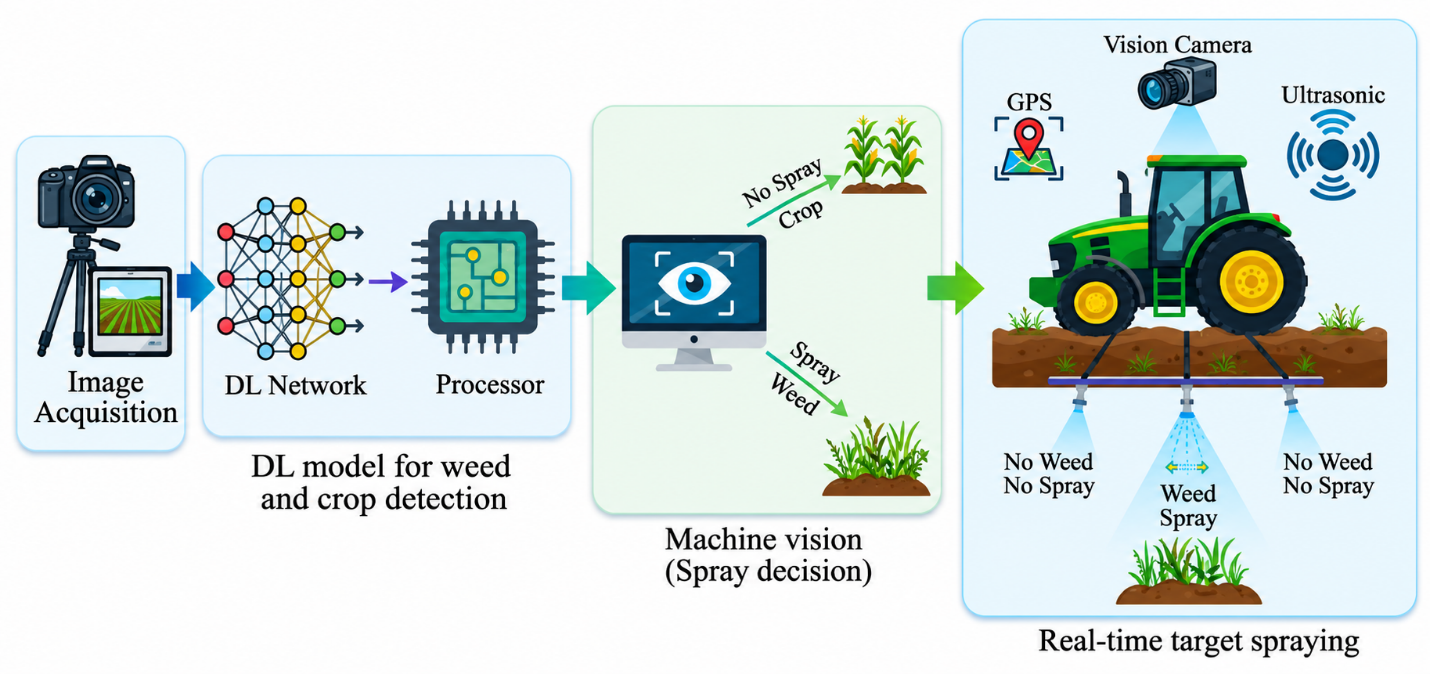
The workflow begins with target monitoring through weed-sensing and imaging; machine vision and deep learning enhance detection, though similar colour, shape and texture between crops and weeds can limit performance (Christensen et al. 2009; Hasan et al. 2021; Jin et al. 2022), with lightweight object-detection models increasingly supporting real-time field implementation (Allmendinger et al. 2025). The key step converts observations into an actionable prescription, integrating target identity, density, location and crop status, represented as a detect-diagnose-decide-prescribe-spray framework implemented through variable-rate application, sectional control, individually actuated nozzles or spot-spraying (Allmendinger et al. 2022; Ye et al. 2025). Real-time implementation requires synchronizing camera-to-nozzle distance, vehicle speed and processing latency, making edge computing and efficient AI models important for reducing delays (Allmendinger et al. 2025).
IPPS can reduce unnecessary herbicide use and off-target spraying, but adoption is constrained by equipment costs and field-validation needs; research has focused predominantly on detection, with less attention to spraying-system performance (Vijayakumar et al. 2023). Future systems will likely integrate multimodal sensing and edge AI, positioning IPPS as a bridge between precision weed management and autonomous crop protection (Ye et al. 2025). The workflow of an intelligent sprayer is depicted in Figure 1.
5.1 Target plant information acquisition
5.1.1 Image-based target information acquisition technology
Image-based acquisition forms the visual foundation of precision spraying, since detection accuracy and timeliness directly shape treatment decisions. Variation in weed species, growth stage, illumination, occlusion and canopy structure make reliable discrimination challenging, requiring imaging systems suited to diverse field conditions (Genze et al. 2022; B. Xu et al. 2025).
Ground-based RGB-depth imaging provides complementary colour and geometric information; (Xu et al. 2021) showed RGB-depth fusion improved weed detection in wheat under natural conditions. UAV imaging adds flexible coverage and high resolution: (Genze et al. 2022) achieved early weed segmentation from motion-blurred UAV sorghum images (F1-score above 89%), and (Xu et al. 2023) developed UAV-based instance segmentation for soybean weed detection. Annotated datasets are equally important: CoFly-WeedDB provides 201 annotated UAV RGB images of a cotton field covering three weed species (Krestenitis et al. 2022); attention-aided segmentation has improved identification of small, scattered weed regions in pineapple (Cai et al. 2023); and weather-driven domain adaptation improved UAV weed-segmentation generalization, achieving 96.2% accuracy in soybean fields (B. Xu et al. 2025). Reliable acquisition thus depends on sensor modality, viewing geometry, acquisition conditions and training-data diversity as much as resolution.
5.1.2 Target information acquisition technology based on remote sensing
Remote sensing identifies and maps weeds across fields and is increasingly integrated with UAV technologies for site-specific management (Huang et al. 2025). Satellite platforms such as Sentinel-2 support broad-area monitoring, with red-edge and near-infrared bands showing strong spectral differences between maize and weeds enabling early detection (Mkhize et al. 2024), though satellite detection is constrained by resolution and weed distribution. (Rasmussen et al. 2021) showed free satellite imagery could map Cirsium arvense but stressed weed aggregation and resolution, while (Peña et al. 2015) showed UAV sensor resolution affects seedling detection; satellites and UAVs therefore serve complementary roles (Huang et al. 2025).
Multispectral sensing records reflectance across discrete bands; indices such as NDVI (Normalised Difference Vegetation Index) , RVI (Ratio Vegetation Index) and NDWI (Normalised Difference Water Index) characterize vegetation cover, vigor and growth dynamics (Xue and Su 2017), offering a practical balance of information, coverage, cost and computation across ground, aerial and satellite platforms. Hyperspectral sensing captures reflectance across numerous narrow bands, improving discrimination among visually similar species and increasingly combined with machine learning (Mensah et al. 2024), though high data volume limits routine deployment compared with RGB/multispectral systems. NIR sensing contributes to vegetation indices assessing canopy condition (Xue and Su 2017) but works best combined with other features.
Thermal infrared sensing measures canopy temperature, reflecting transpiration and physiological stress (Neinavaz et al. 2021); since responses are not weed-specific, it is best used as a complementary layer. Synthetic Aperture Radar (SAR) offers all-weather, all-day observation since radar can penetrate cloud cover and, to some extent, vegetation; backscatter reflects humidity, surface structure and material composition and can support pest/weed identification, though interacting environmental factors complicate interpretation (Ye et al. 2025).
UAVs provide flexible, high-resolution, low-cost data acquisition carrying RGB, multispectral, hyperspectral and thermal sensors; a recent review identified RGB as the most common configuration, with growing integration of multispectral and LiDAR sensing (Sandoval-Pillajo et al. 2025), and (Seiche et al. 2024) showed lower-cost multispectral sensors can approach high-end performance. LiDAR uses laser pulses and return-time measurement to generate 3D vegetation and terrain information for canopy-volume estimation, biomass assessment and phenotyping (Debnath et al. 2023); its illumination-independence complements RGB and spectral sensing, though cost and processing complexity limit broad-acre use.
Overall, these are complementary rather than substitutable: satellites offer coverage, UAVs resolution, multispectral/hyperspectral sensors spectral discrimination, thermal sensing physiological information, SAR all-weather capability, and LiDAR 3D structure, and their integration with AI can strengthen IPPS target information.
5.1.3 Acoustic wave-based target information acquisition
Acoustic-wave sensing here is limited to ultrasonic ranging for weed detection, which estimates plant height and canopy structure rather than detecting sound emitted by the plants. The sensor emits ultrasonic pulses and times the returning echoes to estimate the distance to the canopy; subtracting this from the sensor-to-ground reference distance gives canopy height. Ultrasonic measurements have shown potential for estimating weed biomass and, because grass and broadleaf weeds differ in height and canopy structure, for discriminating between these groups and distinguishing weed-infested from weed-free zones in cereal crops, with reported classification success of approximately 81% for pure grass stands and 92.8% for infested versus non-infested zones under the study conditions (Andújar et al. 2011, 2012). Ultrasonic sensors are relatively inexpensive, operate without contact with plants and suit outdoor use, which makes them attractive for site-specific weed management and real-time patch spraying. However, they rely on canopy height and structure rather than species-specific features, and accuracy depends on weed species, plant density, canopy structure and crop growth stage. As cereal crops develop, overlapping canopies can mask shorter weeds and reduce detection accuracy (Andújar et al. 2012), and readings are also sensitive to leaf angle, travel speed and environmental interference and often underestimate canopy height (Zhao et al. 2022). Acoustic sensing is therefore best used within IPPS as a low-cost layer fused with image-based data, supplying height and biomass information while imaging supplies species-level identification (Ye et al. 2025).
5.1.4 Electronic Nose (E-Nose) technology
Electronic nose (E-Nose) technology uses an array of gas sensors and pattern-recognition algorithms to detect volatile organic compounds (VOCs) emitted by plants, offering a rapid, portable and non-destructive route to plant status monitoring (Cui et al. 2018). E-noses can discriminate VOC profiles among plant species and between undamaged and stressed plants (Laothawornkitkul et al. 2008). They have also recorded volatile signals from soybean–weed combinations under field conditions (Fuentes et al. 2018), suggesting that weed-associated VOC signatures could be sensed in crop stands, and have been tested for identifying herbicide residues on plant surfaces, which could support weed-control decisions (Wilson 2016). However, weed-specific e-nose research is still at an early stage, and it is unclear whether weed species or infestation levels can be identified from field VOC profiles. Field performance is limited by temperature, humidity, background odors, sensor drift, sampling in open air and the difficulty of scaling measurements to field level (Lampson et al. 2014; Cui et al. 2018; Fundurulic et al. 2023), and background VOCs from the crop and from co-occurring plant species can mask weed-specific signals. Calibration and validation against reference methods such as gas chromatography–mass spectrometry (GC–MS) may be necessary to improve the reliability of e-nose measurements. Within IPPS, e-nose sensing complements image, remote-sensing and acoustic data to strengthen identification, and Ye et al. (Ye et al. 2025) highlight the potential of integrating multiple sensing technologies, including image acquisition and acoustic sensing. However, the specific fusion of e-nose, image-based and ultrasonic data for weed detection remains to be validated, so e-nose sensing is best regarded as a promising but technically challenging approach to information acquisition.
5.1.5 IoT-based target information acquisition
IoT integrates field sensors, wireless communication, edge/cloud computing and data platforms for continuous monitoring. LPWAN systems, particularly LoRa, suit agricultural fields via long-range, low-power communication for battery-powered nodes (Križanović et al. 2023), while hybrid LPWAN-5G architectures can complement LPWAN for higher bandwidth, reporting cost reductions up to 30% (Rafi et al. 2026). IoT architectures typically combine field-level sensing, edge processing and cloud analytics, extending the sensing-decision-actuation concept to distributed farm systems (Miller et al. 2025); sensors can monitor soil moisture, temperature and humidity, while connected imaging systems can acquire field-level visual information for automated weed detection and classification using machine-learning/deep-learning approaches, providing spatial weed information for site-specific management and variable-rate herbicide application.
Within IPPS, IoT enables real-time collection of spatial, spectral and temporal data, complementing imaging, remote sensing, acoustic and e-nose technologies (Ye et al. 2025), though adoption remains constrained by connectivity reliability, energy needs, interoperability, cybersecurity, data privacy and infrastructure cost (Naseer et al. 2024; Miller et al. 2025).
5.2 Information processing
Following acquisition through imaging, remote sensing, acoustic, e-nose and IoT technologies, the information-processing layer converts raw observations into reliable decision-making information (Ye et al. 2025), comprising preprocessing, feature/target analysis and model improvement.
Preprocessing is important because labelled field datasets are often limited and imbalanced; class weighting and augmentation reduce the effects of unequal category representation (Bilal et al. 2025; Wang et al. 2025), and diffusion-based synthetic-data generation has shown potential to improve weed-recognition performance when real data are scarce (Chen et al. 2022). Processed data are then analysed to identify diagnostic relationships between sensor features and target organisms; deep-learning models increasingly replace manually engineered features, improving detection under complex conditions (Shoaib et al. 2025; Wang et al. 2025). Model improvement and validation aim to increase accuracy and generalization to unseen conditions; deep learning and multimodal integration can improve real-time recognition, with molecular or chemical analysis providing confirmation when image-based identification is uncertain (Shoaib et al. 2025; Ye et al. 2025).
5.2.1 Information preprocessing techniques
Preprocessing converts raw sensing data into reliable analytical inputs (Ye et al. 2025) through four processes: image preprocessing improves quality via enhancement, denoising and segmentation, separating targets from background (Wu et al. 2024; Minarni et al. 2026); data cleaning handles noise, missing values and outliers (Garcı́a et al. 2015); data enhancement increases dataset diversity through geometric augmentation and generative synthetic samples, with diffusion-based augmentation improving weed-recognition performance using realistic training images (Chen et al. 2022); and data conversion transforms measurements into modelling-suitable forms through normalization and encoding (Garcı́a et al. 2015). Effective preprocessing sets the data-quality ceiling for feature extraction, classification and prescription, making it essential for reliable IPPS performance (Ye et al. 2025).
5.2.2 Target feature extraction and identification of weeds
Feature extraction converts raw sensing data into discriminative information for weed identification, spanning colour, morphology, texture, spectral and spatial characteristics, traditionally combined with machine-learning classifiers though increasingly learned automatically via deep learning (Vijayakumar et al. 2023; Adhinata et al. 2024).
Colour is widely used since plant and non-plant backgrounds differ spectrally; RGB indices such as r-g, g-b and 2g-r-b enable effective separation under varying soil and illumination (Woebbecke et al. 1995), while RGB-to-HSV transformation separates colour from brightness for segmentation (Hamuda et al. 2017). Morphology- leaf shape, area, perimeter, contour- helps distinguish crops from weeds, but reliability declines when species are morphologically similar, so it works best combined with colour, texture or spectral information (Wu et al. 2021; Li et al. 2025). Texture, describing surface roughness, venation and intensity patterns, complements colour and shape: Gabor wavelet and gradient-field features have classified weeds by directional texture (Ishak et al. 2009), wavelet-derived texture enabled segmentation under leaf occlusion in sugar beet (Bakhshipour et al. 2017), and GLCM (Grey-Level Co-occurrence Matrix) or LBP(Local Binary Pattern) descriptors are widely used with machine-learning classifiers (Wu et al. 2021).
Multi-feature approaches combine colour, morphology, texture, spectral or depth information to overcome the sensitivity of individual features to illumination and occlusion; RGB-D fusion improved weed detection in wheat where RGB alone was insufficient (Xu et al. 2021), and recent deep-learning systems integrate multi-scale, multimodal information to detect small weed targets (Adhinata et al. 2024; Li et al. 2025). Feature extraction has thus progressed from manually selected descriptors toward automated, multi-feature deep-learning representations, supporting more reliable identification.
5.2.3 Data mining
Data mining converts large agricultural datasets into useful patterns for weed detection, infestation prediction and management decisions using classification, regression, clustering and association-rule techniques; (Majumdar et al. 2017) applied PAM, CLARA, DBSCAN and multiple linear regression to crop, soil and climatic data to identify parameters linked to production. In precision weed management, data mining can integrate image-derived features, sensor observations and environmental variables to classify targets and predict risk; combined ANN, SVR, k-nearest neighbours and random forest in a dynamic ensemble to predict yellow stem borer populations in rice, with similar approaches explored for weed management (Singh et al. 2024; Mehdizadeh et al. 2025).
Classification methods such as decision trees, random forests and SVM distinguish weed species or risk categories; RF has predicted herbicide-resistance risk, with (Lepke et al. 2024) using field-history data to predict ALS-inhibitor resistance in Alopecurus myosuroides, showing transferability to Lolium spp. Regression estimates infestation severity, clustering identifies spatial patterns, and association-rule mining reveals relationships among practices and outcomes (Majumdar et al. 2017; Sindhu and Sindhu 2017), linking target acquisition with identification of weeds and providing the basis for prescription generation within IPPS (Ye et al. 2025).
5.2.4 Deep learning and image recognition
Deep learning has transformed image-based weed recognition by automatically learning discriminative features from complex imagery, reducing reliance on manual engineering. CNNs, YOLO-based detectors, U-Net and related architectures now support classification, detection and segmentation using RGB, multispectral and UAV imagery (Murad et al. 2023; Rai et al. 2023). (Genze et al. 2022) achieved effective early weed segmentation from motion-blurred UAV sorghum images; (Xu et al. 2023) developed UAV-based instance segmentation for soybean; and (Rai and Sun 2024) developed WeedVision, a single-stage detection-segmentation framework for edge-deployable drone inference, though limited annotated datasets and computational demand remain major challenges, with reviews calling for larger datasets and lightweight, transferable models (Murad et al. 2023; Rai et al. 2023).
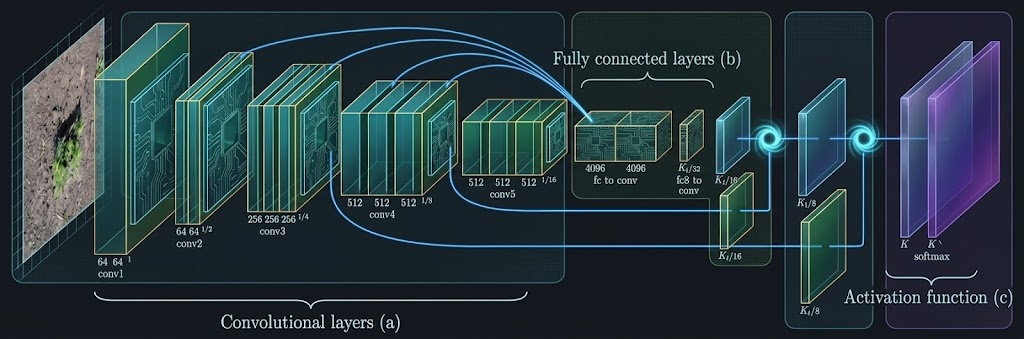
CNNs are among the most widely used architectures for crop-weed recognition, learning hierarchical features through successive convolution and pooling, valuable where crops and weeds appear visually similar, as illustrated in Figure 2. (Jin et al. 2023) evaluated DenseNet, EfficientNet-v2 and ResNet for weed detection and herbicide-susceptibility classification, achieving very high performance though morphologically similar species remained hard to distinguish; (Moazzam et al. 2023) developed a W-shaped CNN for pixel-level crop-weed-background classification. CNNs are increasingly integrated with segmentation frameworks: (Zou et al. 2022) developed a modified U-Net for wheat-weed segmentation achieving 88.98% IoU at 52 fps on embedded devices, and (Xu et al. 2023) combined a ResNet101-based encoder-decoder with colour-index preprocessing for UAV imagery, achieving 0.959 IoU in soybean fields, though computational demand and reduced generalization keep lightweight architectures a priority.
5.3 Pesticide prescription maps
Prescription maps link weed distribution to site-specific application: weed density and position from UAV imagery or machine vision are converted into treatment zones guiding variable-rate or patch spraying. (Huang et al. 2018) demonstrated this in rice using high-resolution UAV imagery and fully convolutional networks, achieving 91.96% weed-mapping accuracy and generating a prescription map for a 50 x 60 m field in under 30 minutes, with threshold-based maps yielding 58.3-70.8% estimated herbicide savings. (Pasta et al. 2025) used UAV RGB/multispectral imagery for maize prescription maps, achieving an initial 70% herbicide-use reduction, and (Han et al. 2025) developed a UAV-based 3D prescription workflow achieving a 32.43% pesticide-use reduction. Effectiveness depends on mapping accuracy, threshold selection, spatial resolution and application-system responsiveness, making standardized formats and real-time variable-rate control important for field-scale IPPS.
5.4 Vehicle automatic control technology
Vehicle automatic control enables machinery to navigate predefined paths with minimal human intervention through GNSS positioning, sensors and motion control, with machine vision or LiDAR improving obstacle avoidance under complex conditions (Pérez-Ruiz et al. 2011; Yao et al. 2023). (Yue et al. 2024) developed a GNSS-based navigation system for a crawler orchard sprayer, achieving a tracking error below 5.6 cm at 1.2 m per second, and (Yao et al. 2023) identified GNSS, machine vision and LiDAR as major navigation approaches, though sensor reliability and cost remain barriers. Vehicle automatic control thus forms the mobility and execution layer of intelligent spraying, and its integration with sensor fusion and path planning can improve application accuracy and reduce operator workload.
5.4.1 Precise spraying technology
Precise spraying applies pesticides only where and at the rate required by integrating sensing, machine vision, GNSS and variable-rate control, adapting spray rate and pattern to canopy, target distribution and field conditions to improve input-use efficiency and reduce off-target losses (Taseer and Han 2024).
Variable-rate spraying (VRS) adjusts flow according to canopy characteristics, disease severity or weed density; (Zhang et al. 2025) combined canopy-volume and disease detection for variable-rate spraying, while (Taseer and Han 2024) reviewed sensor-based VRS approaches. Profiling spraying adjusts boom or nozzle position to crop height and canopy structure, maintaining nozzle-to-target distance; drift studies show lower boom heights and coarser droplets generally reduce drift (Nuyttens et al. 2009; Balsari et al. 2017). Targeted spraying combines machine vision, AI and real-time sensing to identify targets and selectively activate individual nozzles, reducing treated area and pesticide use while maintaining control. Anti-drift spraying reduces off-target pesticide movement through nozzle selection, droplet-size control and boom-height management; (Nuyttens et al. 2009) showed nozzle type and size substantially affect drift, and (Li et al. 2023) reviewed drift-reduction approaches for orchard spraying.
Collectively, these form a “sense-adapt-apply-control” framework converting target information into adjustments in rate, position and droplet characteristics, improving efficiency and reducing drift.
5.4.2 Smart droplet control technologies
Controlling droplet size, density and distribution is essential for optimizing deposition while limiting evaporation, drift and off-target movement; nozzles must balance flow rate, atomization, spray pattern and droplet velocity, since overly fine droplets increase drift while overly coarse droplets reduce coverage (Whitford et al. 2024).
Piezoelectric ultrasonic atomization uses high-frequency vibrations to generate capillary waves that break liquid into fine droplets, with size depending on vibration frequency, power, viscosity and surface tension (Camacho-Lie et al. 2023); it offers precise control and low energy use but is constrained by formulation, throughput and cost. Gas-assisted atomization uses high-velocity air to shear the liquid stream while assisting transport and canopy penetration; (Ou et al. 2024) demonstrated an air-assisted orchard nozzle with controllable droplet size and improved penetration. Centrifugal atomization discharges liquid radially from a rotating disc, with droplet size strongly influenced by disc speed and flow rate, useful for UAV spraying; (He et al. 2024) related nozzle speed and flow rate to optimal particle size in UAV maize spraying, and (S. Xu et al. 2025) showed rotational-speed combinations substantially affect droplet deposition in a multi-nozzle centrifugal system. Electrostatic atomization charges droplets to enhance attraction to plant surfaces via induction, corona or contact charging (Law 2001; Appah et al. 2019); (Zhou et al. 2024) reported a 127.8% increase in charge-to-mass ratio (0.86 to 1.97 mC/kg) as voltage rose from 1,000 to 4,000 V, though formulation compatibility and charge leakage remain practical limits.
Collectively, these provide a “sense-control-atomize-deposit” pathway adapting droplet characteristics to target, crop and operating conditions, and their integration with intelligent sensing and variable-rate control can improve deposition efficiency and reduce drift.
6 Comparison of different smart spraying technologies
| Technology | Working principle | Advantages | Limitations | Study context and reported performance |
|---|---|---|---|---|
| 1. Optical spot-spray sensors (e.g., WeedSeeker, WEED-IT) | Red/near-infrared reflectance sensors on each nozzle or nozzle group switch the nozzle on when green vegetation is detected | Simple; no training data; can be retrofitted to booms; suited to green-on-brown use (fallow, post-harvest, pre-emergence) | Cannot separate crop from weed; at equal herbicide rates efficacy was lower than uniform spraying in Pacific Northwest fallow (Genna et al. 2021) | Field. 23–55% less chemical use (Sharma et al. 2023); 53% less herbicide volume but efficacy 1.5 times higher with uniform spraying in fallow (Genna et al. 2021) |
| 2. Camera and AI targeted spraying on commercial sprayers (e.g., See & Spray Select, Premium, Ultimate) | Boom cameras and deep-learning models detect weeds (Select: green vegetation on fallow; later versions: weeds in crop) and switch individual nozzles | Factory-integrated; area sprayed cut by 20–90% in soybean (Avent et al. 2026); positive net return of US$43.22–129.19 ha-1 | Missed small weeds at the lowest sensitivity raised weed density from 867 to 11,300 plants ha-1 in three years; high capital cost and subscription; residual herbicides still applied broadcast | Field, replicated plots, Arkansas, 2022–2024 (Avent et al. 2026). Average 77% saving for Select on fallow is manufacturer-reported (Deere & Company 2021) |
| 3. Plant-by-plant ultra-high-precision sprayers (e.g., Ecorobotix ARA) | Cameras and AI classify soil, crop and weed; many closely spaced nozzles treat targets as small as 6 × 6 cm | Very large reported input savings (up to 95%); can treat weeds within the crop row (Ecorobotix 2026) | Lower work rate (about 4 ha h-1 at 7.2 km h-1, manufacturer data); high price; depends on controlled lighting | Manufacturer-reported and trade press. Nearly 70% of about 3,000 onion missions saved 80% or more (Ecorobotix 2026). No independent evaluation was located in this search |
| 4. Research prototypes: deep-learning smart sprayers with edge computing | RGB camera, YOLO detector on a Jetson-class device, solenoid valves per grid cell or nozzle | Species-level targeting; low-cost embedded hardware; adaptable to local crops | Accuracy falls outdoors and at higher speed; needs local training data; detection, vehicle movement and nozzle response must be synchronised | Indoor and field. Effective spraying rate 93.33% indoors, 90.6% in the field (Arjun Upadhyay et al. 2024). Field hit accuracy 90.80%, 86.20% and 79.61% at 2, 3 and 4 km h-1 (Li et al. 2022) |
| 5. UAV imagery - prescription map - variable-rate or patch spraying | UAV images are segmented into weed-density maps; threshold maps drive variable-rate or pulse-width-modulation application | Suits patchy infestations; planning done offline, so no real-time latency limit; large area per flight | Delay between mapping and spraying; accuracy depends on resolution, threshold and registration; extra operation and expertise | Field-acquired UAV data. 91.96% mapping accuracy and 58.3–70.8% estimated savings in rice (Huang et al. 2018); 70% reduction in maize (Pasta et al. 2025); 32.43% pesticide reduction (Han et al. 2025) |
| 6. UAV spraying platforms | Multirotor or helicopter sprayers apply liquid through onboard nozzles, optionally with variable-rate control | Flexible access; reduced operator exposure; rental-service model in India (Namo Drone Didi) | Deposition and drift depend on droplet size and nozzle configuration (He et al. 2024; S. Xu et al. 2025) | Engineering evaluations of spray systems |
| 7. Smart droplet-control nozzles (electrostatic, centrifugal, air-assisted, ultrasonic) | Control droplet size, charge and transport to improve deposition and reduce drift | Better deposition and lower drift under test conditions | Evidence is mostly bench, orchard or UAV-nozzle work rather than herbicide boom spraying; formulation compatibility, charge leakage, throughput and cost | Laboratory bench. Air-assisted induction-charging nozzle optimised at 1.5 bar, 0.2 m, 2,500 V (Zhou et al. 2024). Lower boom height and coarser droplets reduce drift (Nuyttens et al. 2009; Balsari et al. 2017) |
| 8. Vision-guided mechanical and robotic weeding | Cameras locate crop and weeds; hoes, robotic tools or band sprayers act in-row or inter-row, often RTK-guided | Herbicide-free (mechanical) or large herbicide savings; efficacy at least equal to herbicide references | Speed, crop damage and soil-condition limits; costs still high | Field. Seven robots at two German sites, 2021–2022: efficacy at least equal to the herbicide standard; band spraying and RTK-guided hoeing saved 75–83% herbicide (Gerhards et al. 2024). 62–87% within-row weed reduction in transplanted cabbage (Tillett et al. 2008) |
| 9. Laser weeding | Vision locates weeds; laser pulses damage the meristem | No herbicide; minimal soil disturbance; suits organic and high-value vegetables | Needs accurate meristem targeting; dwell time, energy use and safety (Yaseen and Long 2024); US$1.2 million purchase price in one case study | Field comparisons in vegetables: comparable to or above selected herbicide treatments, varying with species and emergence (Sosnoskie et al. 2025) |
7 Cost, maintenance and farm-level adoption of smart spraying technologies
Economic performance depends less on the technology itself than on herbicide price, weed pressure, area treated and the up-front investment. At the low-cost end, optical spot-spray controllers fitted to existing booms reduced chemical use by 23–55% in field experiments (Sharma et al. 2023). However, in Pacific Northwest fallow, efficacy at the same herbicide rate was lower than with uniform spraying, so part of the saving can be offset if higher rates are used to compensate (Genna et al. 2021). Camera and AI systems cost more. In a three-year Arkansas soybean study, adding See & Spray Premium capability was costed at US$40,000–80,000 on a US$600,000 sprayer, plus a subscription of US$12.36 ha-1 on the area not sprayed. Targeted programmes cost US$118.57–140.89 ha-1 against US$227.22 ha-1 for broadcast, and the investment paid back after roughly 220–1,270 ha of treated area depending on the sensitivity setting and upgrade cost (Avent et al. 2026). The same study showed that savings can be lost if sensitivity is set too low, because missed weeds raised weed density and the seedbank. At the high-cost end, robotic and laser systems remove or greatly reduce herbicide but need large capital outlays: a Western Growers case study reported a purchase price of US$1.2 million per LaserWeeder and an operating cost of US$267.72 per acre against US$900 per acre for hand weeding in organic baby-leaf crops (Hearden 2025), and (Gerhards et al. 2024) concluded that robotic weeding is effective but its costs remain high. Reviews report that patch spraying typically saves at least 50% of herbicide, yet adoption lags scientific progress because of cost, interoperability and uncertain returns (Gerhards et al. 2022; Lati et al. 2021).
Maintenance and operating needs are reported less often than purchase prices. Reported items include sensor calibration (WeedSeeker sensors need background calibration, whereas WEED-IT calibrates on the go) (Barroso 2021; Genna et al. 2021), detection-model updates and subscription fees for commercial camera systems (Avent et al. 2026), calibration and validation of electronic-nose sensors against reference methods, and energy use, dwell time and safety for laser systems (Yaseen and Long 2024). The Arkansas economic model assumed repair costs of US$1.55–1.68 ha-1 for targeted sprayers against US$1.19 ha-1 for a broadcast sprayer (Avent et al. 2026). Measured maintenance costs from farms are scarce and are a research gap.
Affordability differs sharply by farm size. High-capital machines suit large or high-value operations, whereas small and fragmented holdings need shared ownership, custom hiring or public support. In India, the Namo Drone Didi scheme provides central financial assistance of 80% of the cost of a spraying drone and accessories, up to Rs.8 lakh per drone, to women self-help groups that rent out spraying services to farmers (Ministry of Agriculture and Farmers Welfare, Government of India 2024).
8 Challenges in real-field deployment
Lighting, shadows and wind. Performance measured indoors or under uniform light does not transfer fully to the field. In the smart sprayer of (Arjun Upadhyay et al. 2024), the effective spraying rate was 93.33% indoors and 90.6% in the field, and the authors attributed the drop to lighting, shadows and wind. Colour-index segmentation was designed for varied soil, residue and lighting (Woebbecke et al. 1995), yet remains sensitive to them. Weather-driven domain adaptation raised UAV soybean segmentation accuracy to 96.2% (B. Xu et al. 2025), and some commercial systems such as the Ecorobotix ARA, use cover (Ecorobotix 2026).
Distinguishing crops from weeds. Similar colour, shape and texture limit detection (Christensen et al. 2009; Hasan et al. 2021; Jin et al. 2022), and morphologically similar species remain hard to separate (Jin et al. 2023). Small weeds are the hardest and the most important to catch: with a commercial system at its lowest sensitivity, weed density rose from 867 to 11,300 plants ha-1 over three years because small weeds were missed (Avent et al. 2026). Fusing depth with colour improved detection in wheat (Xu et al. 2021), and larger, more varied annotated datasets are still needed (Murad et al. 2023; Rai et al. 2023).
Spraying accuracy. Detection is only half the task. In field trials, on-target spraying accuracy fell from 90.80% at 2 km h-1 to 79.61% at 4 km h-1 (Li et al. 2022), showing the need to synchronise detection, vehicle speed, processing latency and nozzle response (Vijayakumar et al. 2023; Allmendinger et al. 2025). Insufficient coverage and imperfect detection can also reduce efficacy relative to uniform spraying (Genna et al. 2021), and drift depends on nozzle type, boom height and droplet size (Nuyttens et al. 2009; Balsari et al. 2017).
Resistance risk. Weeds missed at susceptible stages are a resistance-management concern; the Arkansas authors therefore advise keeping broadcast residual herbicides in targeted programmes (Avent et al. 2026).
9 Precision weed control without using herbicides
9.1 Non-chemical and robotic weed-control technologies
Non-chemical weed control technologies, including mechanical, thermal, and directed-energy methods, are increasingly integrated with machine vision and autonomous robotics because of herbicide resistance and the demand for sustainable production.
Mechanical weeding physically uproots, buries or damages weeds and remains effective against young weeds under suitable conditions. Machine-vision-guided intra-row cultivation improves on conventional blind cultivation by distinguishing crop positions; in transplanted cabbage, a vision-guided system achieved 62-87% within-row weed reduction with low crop damage (Tillett et al. 2008).
Laser weeding uses concentrated optical energy to damage weed tissue with minimal soil disturbance. Effectiveness depends on accurately targeting the weed meristem, while dwell time, energy use, cost and safety remain constraints (Yaseen and Long 2024).
Robotic weeding integrates these methods with autonomous navigation, machine vision and precision actuation. A field comparison of seven robotic systems in sugar beet and rapeseed found weed-control efficacy comparable to or exceeding herbicide reference treatments; several hoeing robots achieved 92-94% weed control, while band spraying and RTK-guided hoeing achieved substantial herbicide savings (Gerhards et al. 2024). Platforms such as Robocrop, Dino, BoniRob, FarmDroid and Carbon Robotics’ LaserWeeder illustrate this diversification: Robocrop pioneered vision-guided intra-row cultivation in transplanted vegetables (Fennimore et al. 2014; Gerhards et al. 2024), while the remotely operated WeeRo achieved 81.6% weeding efficiency at 4.5% crop damage in raised-bed fields and 74.9% efficiency at 14.6% damage in flat fields (Khadatkar et al. 2025).
Overall, these technologies reduce herbicide dependence but involve trade-offs among precision, speed, cost, energy use and field adaptability, and are best viewed as complementary components of integrated weed management.
10 Conclusion
Precision weed management is evolving from uniform herbicide application toward data-driven, site-specific and intelligent crop protection. Advances in optical, IoT and acoustic sensing, UAVs, machine vision, deep learning and data analytics enable increasingly accurate detection and characterization of weeds. These target-information technologies, integrated with pesticide prescription maps, GNSS-based navigation, autonomous control and variable-rate, targeted and smart droplet application, establish a workflow linking target detection and interpretation with prescription generation and site-specific application, reducing unnecessary pesticide use, improving application precision and minimizing off-target losses while maintaining effective weed control. Non-chemical technologies, including laser, thermal and robotic/mechanical control, further broaden the potential for sustainable weed management. Despite substantial progress, cost, sensor and model robustness, data availability, environmental variability, interoperability and field-scale validation remain major barriers to widespread adoption. Future research should prioritize lightweight and generalizable AI, multimodal sensing, real-time edge processing, standardized prescription systems and autonomous field validation. Overall, the convergence of sensing, artificial intelligence and precision application technologies provides a strong pathway toward more efficient, economically viable and environmentally sustainable weed management.
11 Abbrevations used
AI – Artificial Intelligence; ALS – Acetolactate Synthase; ANN – Artificial Neural Network; CLARA – Clustering Large Applications; CNN – Convolutional Neural Network; DBSCAN – Density-Based Spatial Clustering of Applications with Noise; DenseNet – Densely Connected Convolutional Network; DL – Deep Learning; E-nose – Electronic Nose; FLIR – Forward-Looking Infrared; fps – Frames Per Second; GC–MS – Gas Chromatography–Mass Spectrometry; GIS – Geographic Information System; GLCM – Grey-Level Co-occurrence Matrix; GNSS – Global Navigation Satellite System; HSV – Hue–Saturation–Value; IoT – Internet of Things; IoU – Intersection over Union; IPPS – Intelligent Pesticide Prescription Spraying; LBP – Local Binary Pattern; LiDAR – Light Detection and Ranging; LoRa – Long Range; LPWAN – Low-Power Wide-Area Network; ML – Machine Learning; NDVI – Normalised Difference Vegetation Index; NDWI – Normalised Difference Water Index; NIR – Near-Infrared; PAM – Partitioning Around Medoids; PWM – Precision Weed Management; RF – Random Forest; RGB – Red–Green–Blue; RGB-D – Red–Green–Blue–Depth; ResNet – Residual Network; RTK – Real-Time Kinematic; RVI – Ratio Vegetation Index; SAR – Synthetic Aperture Radar; SSWM – Site-Specific Weed Management; SVM – Support Vector Machine; SVR – Support Vector Regression; UAV – Unmanned Aerial Vehicle; VOC – Volatile Organic Compound; VRS – Variable-Rate Spraying; YOLO – You Only Look Once; 5G – Fifth-Generation (mobile network)
Artificial intelligence (AI) tools were used solely for grammatical correction and language improvement. The authors reviewed and verified all content and take full responsibility for the accuracy and integrity of the manuscript.
References
Publication Information
- Submitted: 04 September 2026
- Accepted: 08 October 2026
- Published (Online): 09 October 2026
Reviewer Information
Reviewer 1:
Dr.Bindhu J S
Assistant Professor
Kerala Agricultural UniversityReviewer 2:
Dr. Ankit Saini
Assistant Professor and Head
Eternal University, Baru Sahib
The statements, opinions and data contained in all publications are solely those of the individual author(s) and contributor(s) and not of the publisher and/or the editor(s).
The publisher and/or the editor(s) disclaim responsibility for any injury to people or property resulting from any ideas, methods, instructions or products referred to in the content.
© Copyright (2026): Author(s). The licensee is the journal publisher. This is an Open Access article distributed under the terms of the Creative Commons Attribution-NonCommercial-NoDerivatives 4.0 International License, which permits non-commercial use, sharing, and reproduction in any medium, provided the original work is properly cited and no modifications or adaptations are made.